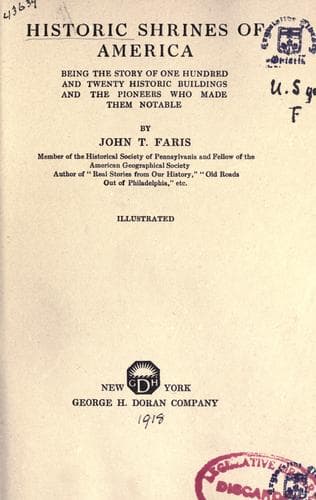
Historic Shrines of America: Being the Story of One Hundred and Twenty Historic Buildings and the Pioneers Who Made Them NotableFaris, John T. (John Thomson)
History
Historic Shrines of America: Being the Story of One Hundred and Twenty Historic Buildings and the Pioneers Who Made Them Notable
Faris, John T. (John Thomson)
Historic buildings -- United States; United States -- Biography
The stone steps on the new building, which are still in use, were
brought from England in 1772. A copy of the letter in which William
Wilson acknowledged their receipt is in a letter book preserved in the
library of the Episcopal Seminary, near Alexandria.
During the Revolution, the patriots were called together, from time to
time, by the bell in the picturesque tower. It was fitting, then, that
when American independence was celebrated at Williamsburg, on May 1,
1783, the Courthouse was made the rallying place for the people. On
receipt of official notice from Governor Benjamin Harrison that the
treaty of peace had been signed, the mayor of Williamsburg prepared an
"Order of the Procession on the Great Day," which closed with the
following direction:
"The Citizens to be Conveyed on Thursday, at 1 o'clock at the
Court-House by a Bellman.
"After the convention of citizens they are to make
proclamation at the C: House, after which the Bells at the
Church, College, & Capitol are to ring in peal.
"From the Ct House the Citizens are to proceed to the
College, and make proclamation at that place, from whence
they are to proceed to the Capitol and make proclamation
there and from thence Proceed to the Raleigh (Tavern) & pass
the rest of the day."
A frequent visitor to the Williamsburg Courthouse was the brilliant
lawyer Patrick Henry, whose reputation as an orator was made long
before he delivered his "Give me Liberty or Give me Death" speech at
St. John's Church, Richmond.
Some years before the Williamsburg Courthouse was erected, this orator
made his first public speech, at Hanover Courthouse, a building that
dates from 1735, in the celebrated suit of the clergy demanding the
payment of their stipends in tobacco, according to law. In consequence
of a short crop the price had increased, and they insisted that it was
their right to have the advantage of the increase. Their case had been
tried once and won. The attorney of the people thereupon withdrew, and
Henry was engaged to appear for them in court.
When the case was called, Rev. Patrick Henry was present, to the
regret of his nephew. The lawyer sought his uncle and said that he
feared he would be too much overawed by his presence to do his duty to
his clients, and added that he would be compelled to say some "very
hard things of the clergy." The minister thereupon entered his
carriage, and drove away.
William Wirt describes the scene at the opening of the case:
Public-domain text, read in full here on John Shaqi.
Reviews
Reviews
No reviews yet
Be the first to share your thoughts on this work.
Elsewhere in the archive
Join the Discussion
Join the discussion
Sign in to leave a comment or review.
Sign InorCreate an account