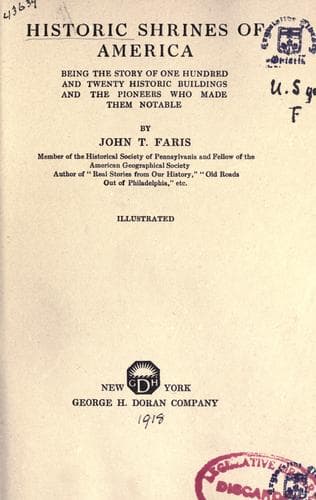
Historic Shrines of America: Being the Story of One Hundred and Twenty Historic Buildings and the Pioneers Who Made Them NotableFaris, John T. (John Thomson)
History
Historic Shrines of America: Being the Story of One Hundred and Twenty Historic Buildings and the Pioneers Who Made Them Notable
Faris, John T. (John Thomson)
Historic buildings -- United States; United States -- Biography
During the siege of Yorktown he was at the head of the militia. The
sketch of his life as given by Sanderson in the "Biography of the
Signers," says: "During the siege, observing his own house uninjured
by the artillery of the American batteries he inquired the cause. A
respect for his property, was assigned. Nelson ... requested that the
artillerists would not spare his house more than any other, especially
as he knew it to be occupied by the principal officers of the British
Army. Two pieces were accordingly pointed against it. The first shot
went through the house and killed two ... officers.... Other balls
soon dislodged the hostile tenants." It is said that Nelson gave ten
guineas reward to the man who fired the first shot.
Again Thomas Nelson responded to the call of his State when in June,
1781, he became Governor, succeeding Thomas Jefferson. Four months
after the beginning of his term as chief executive of the State,
George Washington, in general orders, said:
"The General would be guilty of the highest ingratitude, a
crime of which he hopes he shall never be accused, if he
forgot to return his sincere acknowledgments to his
excellency governor Nelson, for the succours which he
received from him and the militia under his command, to whose
activity, emulation, and bravery, the highest praises are
due. The magnitude of the acquisition will be ample
compensation for the difficulties and dangers which they met
with so much firmness and patriotism."
Nelson's term as Governor was shortened by ill health. In November,
1781, he was compelled to resign.
But he was not permitted to rest. Attacks were made on him for certain
courses taken during his term as Governor. When he asked and was given
permission to defend himself before the State delegates, he was
triumphantly acquitted of all blame. On December 31, 1781, this action
was recorded:
Public-domain text, read in full here on John Shaqi.
Reviews
Reviews
No reviews yet
Be the first to share your thoughts on this work.
Elsewhere in the archive
Join the Discussion
Join the discussion
Sign in to leave a comment or review.
Sign InorCreate an account