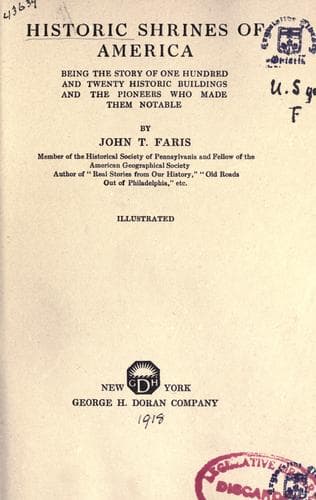
Historic Shrines of America: Being the Story of One Hundred and Twenty Historic Buildings and the Pioneers Who Made Them NotableFaris, John T. (John Thomson)
History
Historic Shrines of America: Being the Story of One Hundred and Twenty Historic Buildings and the Pioneers Who Made Them Notable
Faris, John T. (John Thomson)
Historic buildings -- United States; United States -- Biography
"An act to indemnify THOMAS NELSON, JUNIOR, Esquire, late
governor of this commonwealth, and to legalize certain acts
of his administration. Whereas, upon examination, it appears
that previous to and during the siege of York, Thomas Nelson,
Esquire, late governor of this commonwealth, was compelled by
the peculiar circumstances of the state and army, to perform
many acts of government without the advice of the council of
state, for the purpose of procuring subsistence for the
allied army under the command of his excellency general
Washington; be it enacted that all such acts of government,
evidently productive of general good, and warranted by
necessity, be judged and held of the same validity, and the
like proceedings be had on them as if they had been executed
by and with the advice of the council, and with all the
formality prescribed by law. And be it enacted that the said
Thomas Nelson, jr., Esquire, be and he hereby is in the
fullest manner indemnified and exonerated from all penalties
and dangers which might have accrued to him from the same."
Nelson lived more than seven years after this act approving his
emergency actions. But three years were spent in comparative poverty.
Most of his property was sold to satisfy the debts incurred by paying
two regiments out of his own pocket, and by going security, with the
State, for two million dollars needed to carry on the war. Sanderson
says of these acts of generosity:
"He had spent a princely fortune in his country's service;
his horses had been taken from the plough, and sent to drag
the munitions of war; his granaries had been thrown open to a
starving soldiery, and his ample purse had been drained to
its last dollar, when the credit of Virginia could not bring
a sixpence into her treasury. Yet it was the widow of this
man who, beyond eighty years of age, blind, infirm, and poor,
had yet to learn whether republics can be grateful."
On the simple gravestone in Yorktown, erected to the memory of the
patriot, is this eloquent inscription:
Thomas Nelson,
Governor of Virginia.
He Gave All for Liberty.
Not far from the grave is another historic house that should be named
with the Nelson house. This is the Moore house, on Temple farm, then
less than a mile from Yorktown. In this house, which was built in
1713, the terms of the surrender of Cornwallis were drawn up. It was
once the summer home of the colonial governor, Alexander Spottswood.
LX
THE JOHN MARSHALL HOUSE, RICHMOND, VIRGINIA
WHERE THE CHIEF JUSTICE CARED FOR HIS WIFE AND ENTERTAINED HIS FRIENDS
Public-domain text, read in full here on John Shaqi.
Reviews
Reviews
No reviews yet
Be the first to share your thoughts on this work.
Elsewhere in the archive
Join the Discussion
Join the discussion
Sign in to leave a comment or review.
Sign InorCreate an account