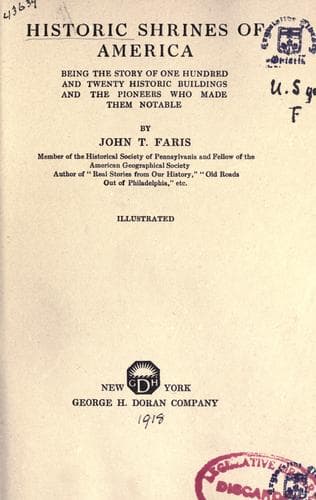
Historic Shrines of America: Being the Story of One Hundred and Twenty Historic Buildings and the Pioneers Who Made Them NotableFaris, John T. (John Thomson)
History
Historic Shrines of America: Being the Story of One Hundred and Twenty Historic Buildings and the Pioneers Who Made Them Notable
Faris, John T. (John Thomson)
Historic buildings -- United States; United States -- Biography
Mrs. Marshall was for many years a nervous invalid. Bishop Meade says,
"The least noise was sometimes agony to her whole frame, and his
perpetual endeavor was to keep the house and yard and out-houses from
the slightest cause of distressing her; walking himself at times about
the house and yard without shoes." The attitude of the people of
Richmond to the husband and wife is shown by the fact that "on one
occasion, when she was in her most distressing state, the town
authorities manifested their great respect for him and sympathy for
her, by having either the town clock or town bell muffled."
On his marriage John Marshall took his wife to one of the best houses
then available in the village of Richmond, a two-room frame building.
In 1789 he bought two acres of ground on Shockoe Hill, and here, in
1793, he built a nine-room brick house. One of the rooms was a large
apartment, in which he gave his famous "lawyer dinners."
When Marshall was not in Washington, he lived in this comfortable
house, which was near the home of his father-in-law. He had also a
farm a few miles from Richmond. Bishop Meade says that one morning,
between daybreak and sunrise, he met Marshall on horseback. He had a
bag of clover seed lying before him, which he was carrying to his
farm.
An English traveller who spent a week in Richmond in 1835 gave his
impression of the Richmond home:
"The house is small, and more humble in appearance than those
of the average of successful lawyers and merchants. I called
there three times upon him; there is no bell to the door.
Once I turned the handle of it and walked in unannounced; on
the other two occasions he had seen me coming, and had lifted
the latch and received me at the door, although he was at the
time suffering from severe contusions received in the stage
while travelling on the road from Fredericksburg to
Richmond."
Chief Justice Marshall frequently attended the Monumental Church. The
narrow pews troubled him, for he was quite tall. "Not finding room
enough for his whole body within the pew, he used to take his seat
nearest the door of his pew, and, throwing it open, let his legs
stretch a little into the aisle."
The death of his wife was a great grief to him. "Never can I cease to
feel the loss and to deplore it," he wrote on December 25, 1832, the
anniversary of her death. "Grief for her is too sacred ever to be
profaned on this day, which shall be, during my existence, marked by a
recollection of her virtues."
He survived Mrs. Marshall less than five years. In June, 1835, he went
to Dr. Physic in Philadelphia, seeking relief for a disability that
had been aggravated by the road accident of which the English visitor
wrote, as already quoted. There he died, July 6, 1835. On July 4 he
wrote the inscription which he wished placed above his grave:
Public-domain text, read in full here on John Shaqi.
Reviews
Reviews
No reviews yet
Be the first to share your thoughts on this work.
Elsewhere in the archive
Join the Discussion
Join the discussion
Sign in to leave a comment or review.
Sign InorCreate an account