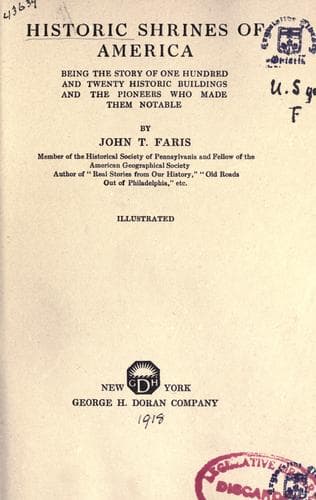
Historic Shrines of America: Being the Story of One Hundred and Twenty Historic Buildings and the Pioneers Who Made Them NotableFaris, John T. (John Thomson)
History
Historic Shrines of America: Being the Story of One Hundred and Twenty Historic Buildings and the Pioneers Who Made Them Notable
Faris, John T. (John Thomson)
Historic buildings -- United States; United States -- Biography
An old book, "Richmond in By Gone Days," says that John Marshall was
noted in Richmond for his unpretending manner. "His dress was plain
even to negligence. He marketed for himself and might be seen at an
early hour returning home with a pair of fowls, or a basket of eggs in
his hand, not with ostentatious humility, but for mere convenience."
It is related by Flanders that Marshall "was one morning strolling
through the streets of Richmond, attired in a plain linen roundabout
and shorts, with his hat under his arm, from which he was eating
cherries, when he stopped in the porch of the Eagle Hotel, indulged in
some little pleasantry with the landlord, and then passed on." Just
then a man from the country, who wished a lawyer to appear for him in
court, was referred by the landlord to Marshall, as the best advocate
he could have, but the countryman declined to have anything to do with
the careless young man. In court he asked the clerk for a lawyer, and
was once more recommended to take John Marshall. Again he refused.
Just then a dignified old man in powdered wig and black coat entered.
He was at once engaged, on his appearance. After a time the
inferiority of the black-coated lawyer was so apparent that the
countryman sought Marshall, told him of the mistake he had made, said
that he had left but five dollars of the one hundred dollars he had
set aside for lawyers' fees, and asked Marshall if he would assist on
the case. The lawyer laughingly agreed.
In 1781, when Marshall was twenty-five years old, he walked from
Virginia to Philadelphia, to be inoculated for smallpox. "He walked at
the rate of thirty-five miles a day. On his arrival, such was his
shabby appearance, that he was refused admission into one of the
hotels; his long beard, and worn-out garments, probably suggesting the
idea that his purse was not adequate to his entertainment. And this in
the city which had seen much of the young man's heroic services during
the Revolution!"
Before the close of the war, while visiting his father, Colonel
Marshall, who was the commanding officer at Yorktown, Virginia, he met
Mary Willis Ambler, a daughter of Jacqueline Ambler, the treasurer of
Virginia. "She was just fourteen years of age at the time, and it is
stated to have been a case of love at first sight." Even when Marshall
called to see her he was not prepossessing in appearance, yet he was
well received, "notwithstanding his slouched hat, and negligent and
awkward dress," for his amiable manners, fine talents, and especially
his love for poetry, which he read to them with deep pathos, led them
to forget his dress.
The young people were married on January 3, 1783. After paying the fee
of the minister, the groom's sole remaining fortune was a guinea!
Public-domain text, read in full here on John Shaqi.
Reviews
Reviews
No reviews yet
Be the first to share your thoughts on this work.
Elsewhere in the archive
Join the Discussion
Join the discussion
Sign in to leave a comment or review.
Sign InorCreate an account