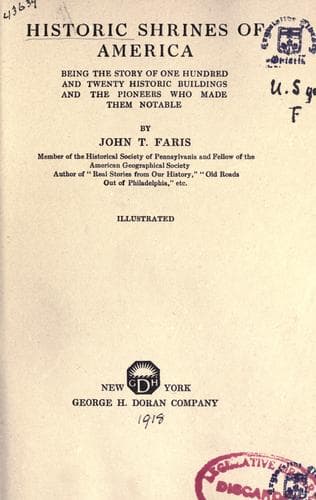
Historic Shrines of America: Being the Story of One Hundred and Twenty Historic Buildings and the Pioneers Who Made Them NotableFaris, John T. (John Thomson)
History
Historic Shrines of America: Being the Story of One Hundred and Twenty Historic Buildings and the Pioneers Who Made Them Notable
Faris, John T. (John Thomson)
Historic buildings -- United States; United States -- Biography
To the home of George Mason other men of note delighted to come. In
the guest room Jefferson and Richard Henry Lee, as well as Washington,
slept more than once. Patrick Henry, too, was a welcome visitor at
Gunston Hall. George Mason had as high an opinion of the orator as
Patrick Henry had of the statesman. "He is by far the most powerful
speaker I ever heard," Mason once said of Henry; "every word he says
not only engages but commands the attention; and your passions are no
longer your own when he addresses them. But his eloquence is the
smallest part of his merit. He is in my opinion the first man upon
this continent, as well in abilities as public virtues, and had he
lived in Rome about the time of the first Punic War, when the Roman
people had arrived at their meridian glory and their virtue not
tarnished, Mr. Henry's talents must have put him at the head of that
glorious commonwealth."
The orator returned the compliment by calling Mason one of the two
greatest statesmen he ever knew.
George Mason's statesmanlike vision was seen in 1766, when he warned
the British public of the results that would follow coercion. "Three
millions of people driven to desperation are not an object of
contempt," he wrote. Again he proved a good prophet when he wrote to
George Washington, on April 2, 1776, after the General took possession
of Boston:
"I congratulate you most heartily upon this glorious and
important event--an event which will render George
Washington's name immortal in the annals of America, endear
his memory to the latest posterity, and entitle him to those
thanks which heaven appointed as the reward of public
virtue."
Mason was of a retiring disposition, and he would have preferred to
remain at home. But he was forced into the councils of the Virginia
Convention, and during his service there he prepared the marvellous
Bill of Rights which was later made a part of the Constitution of that
State and was the model for similar documents in many other States. He
was also the author of the Constitution of Virginia, and the designer
of the State seal. He was a member of the Constitutional Convention in
Philadelphia, where he proved himself "the champion of the State and
the author of the doctrine of State Rights." Because the Constitution
as finally drafted by the convention contained so many provisions that
he felt were dangerous, he refused to sign the document, "declaring
that he would sooner chop off his right hand than put it to the
Constitution" whose provisions he could not approve.
After the Constitutional Convention for more than four years the
statesman lived quietly at Gunston Hall. When he died in October,
1792, he asked to be buried by the side of his first wife, whose death
in 1773 had been a grievous blow to him. Over her tomb he had
inscribed:
Public-domain text, read in full here on John Shaqi.
Reviews
Reviews
No reviews yet
Be the first to share your thoughts on this work.
Elsewhere in the archive
Join the Discussion
Join the discussion
Sign in to leave a comment or review.
Sign InorCreate an account