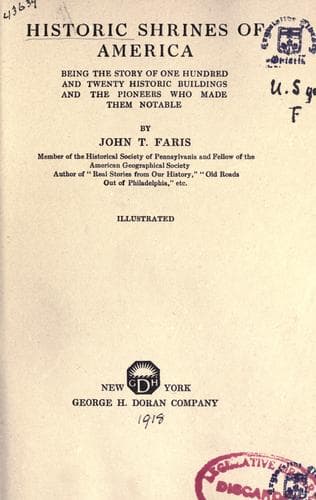
Historic Shrines of America: Being the Story of One Hundred and Twenty Historic Buildings and the Pioneers Who Made Them NotableFaris, John T. (John Thomson)
History
Historic Shrines of America: Being the Story of One Hundred and Twenty Historic Buildings and the Pioneers Who Made Them Notable
Faris, John T. (John Thomson)
Historic buildings -- United States; United States -- Biography
"Once She was all that cheers and sweetens Life;
The tender Mother, Daughter, Friend and Wife:
Once She was all that makes Mankind adore;
Now view the Marble, and be vain no more."
No monument was ever raised over his own grave. A grandson planned to
set a stone inscribed to "The Author of the Bill of Rights and the
Constitution of Virginia," but he was unable to do as he wished.
Gunston Hall still stands, though it has passed through many hands
since the death of him whom George Esten Cooke called "one of the most
remarkable men, not only of his Country, and of his epoch, but of all
Countries and all time."
[Illustration: WASHINGTON COLLEGE BUILDING, LEXINGTON, VA.
_Photo by Ph. B. Wallace_
See page 285]
LXIII
THE WASHINGTON COLLEGE BUILDING, LEXINGTON, VIRGINIA
HOW GEORGE WASHINGTON SOLVED A DELICATE PROBLEM
Even before the treaty of peace with Great Britain was signed, George
Washington was making plans for the development of the West. He was
especially impressed with the possibilities of the Potomac and James
rivers, if improved by canals, as a means of communication with the
Ohio. Companies were organized to the work. In both enterprises he was
a stockholder. On August 13, 1785, he wrote to Edmund Randolph:
"The great object for the accomplishment of which I wish to
see the inland navigation of the River Potomack and James
improved and extended is to connect the western territory
with the Atlantic states.... I have already subscribed five
shares to the Potomack navigation; and enclosed I give you a
power to put my name down for five shares to that of James
River."
In 1785 Patrick Henry, Governor of Virginia, wrote to Washington that
the General Assembly of the State had voted to give him one hundred
shares in the James River Company, "it being their wish, in
particular, that those great works of improvement, which, both as
springing from the liberty which he has been so instrumental in
establishing, and as encouraged by his patronage, will be durable
monuments of his glory, may be made monuments also of the gratitude of
his country."
Washington replied that he could not accept money for his services to
his country. Then he added: "But if it should please the General
Assembly to permit me to turn the destination of the fund vested in
me, from my private emolument, to objects of a public nature, it will
be my study in selecting these to prove the sincerity of my gratitude
for the honor conferred on me, by preferring such as may appear most
subservient to the enlightened and patriotic views of the
legislature."
Of course the legislature granted the desired permission, indicating
that the gifts might be made either during Washington's life, or by
bequest.
Public-domain text, read in full here on John Shaqi.
Reviews
Reviews
No reviews yet
Be the first to share your thoughts on this work.
Elsewhere in the archive
Join the Discussion
Join the discussion
Sign in to leave a comment or review.
Sign InorCreate an account