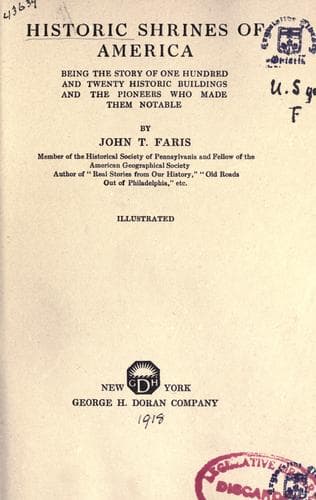
Historic Shrines of America: Being the Story of One Hundred and Twenty Historic Buildings and the Pioneers Who Made Them NotableFaris, John T. (John Thomson)
History
Historic Shrines of America: Being the Story of One Hundred and Twenty Historic Buildings and the Pioneers Who Made Them Notable
Faris, John T. (John Thomson)
Historic buildings -- United States; United States -- Biography
When Virginia was about to go to war with Great Britain, the House of
Burgesses, on May 24, 1774, ordered that "the members of the House do
attend in their places, at the hour of ten in the morning, on the
first day of June next, in order to proceed with the Speaker and the
mace, to the church," for fasting, humiliation, and prayer. During the
Revolution the members of the church were noted for their loyalty to
the Colonies.
To-day the building is about as it was during the troubled days of the
war. No change has been made in the exterior, but in 1839 the interior
was changed in many important particulars. In 1905, however, it was
restored as before. The pulpit was put in the old place. The canopy
and curtain which had long stood above the pew of Governor Spotswood,
were found and again put in position. King Edward VII gave the new
pulpit Bible, and President Roosevelt provided the lectern.
LXV
WILLIAM AND MARY COLLEGE, WILLIAMSBURG, VIRGINIA
THE ALMA MATER OF THOMAS JEFFERSON, JAMES MONROE, AND JOHN TYLER
Three years before John Harvard left a legacy for the founding of the
college that bears his name, the first bequest for public education
made by a resident of Virginia was recorded, though this was used for
a secondary school, rather than for a college.
The project of a college, proposed in 1617 and 1618 by the London
Company, and in 1619 at the first session of the General Assembly,
languished until 1685, when Rev. James Blair came to the Colony as a
missionary and settled in Henrico County, where it had been proposed
to found the college sixty-eight years earlier. For five years he
brooded over the need of a college and in 1690 he made to a convention
at Jamestown "Severall Propositions for a free school and college, to
be humbly presented to the consideration of the next general
assembly." Later, by authority of the Assembly, Dr. Blair appealed to
the Merchants of London, "especially such as traffick with Virginia,"
and three thousand pounds were pledged.
On the occasion of Dr. Blair's visit to England in 1691, he had an
audience with King William, at which he presented the petition for "a
charter to erect a free school and college." The king replied, "Sir, I
am glad that the Colony is upon so good a design, and will promote it
to the best of my power." Queen Mary also showed her interest in the
college.
Public-domain text, read in full here on John Shaqi.
Reviews
Reviews
No reviews yet
Be the first to share your thoughts on this work.
Elsewhere in the archive
Join the Discussion
Join the discussion
Sign in to leave a comment or review.
Sign InorCreate an account