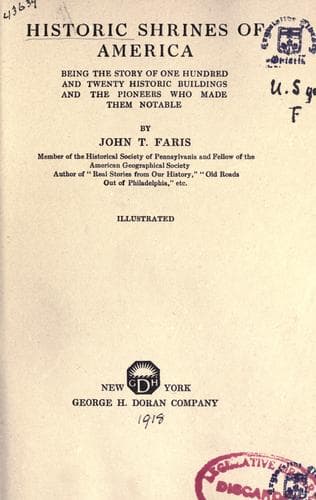
Historic Shrines of America: Being the Story of One Hundred and Twenty Historic Buildings and the Pioneers Who Made Them NotableFaris, John T. (John Thomson)
History
Historic Shrines of America: Being the Story of One Hundred and Twenty Historic Buildings and the Pioneers Who Made Them Notable
Faris, John T. (John Thomson)
Historic buildings -- United States; United States -- Biography
To the endowment in lands and taxes provided by royal order, Dr. Blair
secured an appreciable addition in an ingenious manner. Learning that,
some time before his arrival, the authorities had promised forgiveness
to pirates who, before a set day, should confess their crimes and give
up a portion of their booty, and that three famous pirates had come in
after the appointed day, so that they were arrested, he visited them
in jail and offered to use his influence in their behalf, if they
would consent to give to the college a portion of their booty. They
gladly agreed; Dr. Blair's efforts were successful, and they were
given their liberty together with their treasure, minus the promised
gift to the Virginia College. Another much larger gift was secured
from the executor of an estate which held money devised indefinitely
for "pious and charitable uses." The income from this portion of the
endowment was to be used "to keep as many Indian children in meat,
drink, washing, clothes, medicine, books and education, from the first
beginning of letters till they should be ready to receive orders and
be sent abroad to convert the Indians."
In connection with the charter for "the College of William and Mary,"
which was dated February 8, 1693, authority was given to use the seal
described as follows: "On a green field a college building of silver,
with a golden sun, showing half its orb, rising above it." This is
said to be the sole instance of a college, either English or American,
which has a seal of such high origin.
Sir Christopher Wren, the designer of St. Paul's Cathedral, made the
plan for the original building, which was to be two stories and a half
high, one hundred and thirty-six feet long, and forty feet wide, and
with two wings sixty feet long and twenty-five feet wide. In 1697 it
was reported to the governor of the province that the front and north
side of the proposed rectangle had been completed at Williamsburg, and
that funds were exhausted. The walls were more than three feet thick
at the base, and contained 840,000 bricks, the product of a brickyard
nearby.
For some years subscriptions were paid slowly, and interest in the
college languished, but conditions improved when King William sent to
Governor Nicholson a proclamation urging him "Yt you call upon ye
persons yt have promised to contribute towards ye maintenance of ye
sd college, to pay in full the severall Contributions."
Public-domain text, read in full here on John Shaqi.
Reviews
Reviews
No reviews yet
Be the first to share your thoughts on this work.
Elsewhere in the archive
Join the Discussion
Join the discussion
Sign in to leave a comment or review.
Sign InorCreate an account