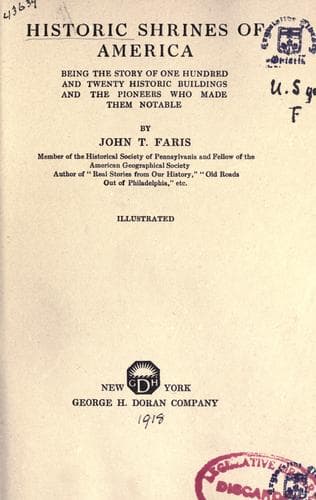
Historic Shrines of America: Being the Story of One Hundred and Twenty Historic Buildings and the Pioneers Who Made Them NotableFaris, John T. (John Thomson)
History
Historic Shrines of America: Being the Story of One Hundred and Twenty Historic Buildings and the Pioneers Who Made Them Notable
Faris, John T. (John Thomson)
Historic buildings -- United States; United States -- Biography
The estate was still the property of Mr. Madison's father, and both
his father and mother continued to live there. Before long the house
was enlarged. The rooms so long occupied by the old people were made a
part of the new mansion.
The two families lived together in perfect harmony. The father lived
to see his son President of the United States, and the mother was
ninety-eight when she died. William O. Stoddard, in his "Life of James
Madison," says that "she kept up the old-fashioned ways of
housekeeping; waited upon by her servants who grew old and faded away
with her. She divided her time between her Bible and her knitting, all
undisturbed by the modern hours, the changed customs, or the elegant
hospitality of the mansion house itself. She was a central point in
the life of her distinguished son, and the object of his most devoted
care to the end of her days."
For Mr. and Mrs. Madison, real life at Montpelier began in 1817, after
the close of the stirring period in the White House. They did not have
much opportunity to be alone, for guests delighted to come to them,
and they liked to have others with them, yet they managed to secure a
wonderful amount of joy out of the years spent "within a squirrel's
jump of heaven," to use Dolly Madison's expressive phrase.
Among the guests were intimate friends like Jefferson, who was almost
a member of the family. Lafayette, too, found his way to the estate,
while Harriet Martineau told in her "Recollections" of her pleasant
sojourn there. Frequently strangers who were on the way to the
Virginia Hot Springs took the five-mile detour merely to reach
Montpelier, and they were always made welcome.
The dining-room was large, but there were sometimes so many guests
that the table had to be set out of doors. Mr. Madison wrote in 1820
of one such occasion: "Yesterday we had ninety persons to dine with us
at our table, fixed on the lawn, under a large arbor.... Half a dozen
only staid all night."
After a visit to her parents that was broken into by the presence of
guests, a daughter of the house complained to her husband that she had
not been able to pass one sociable moment with her father. His reply
was sympathetic: "Nobody can ever have felt so severely as myself the
prostration of family society from the circumstances you mention....
But there is no remedy. The present manners and ways of our country
are laws we cannot repeal. They are altering by degrees, and you will
live to see the hospitality of the country reduced to the visiting
hours of the day, and the family left to tranquillity in the evening."
When the steward saw that Madison would not curb these guests, he
began to cut down on the fodder for the horses, but when the
hospitable host learned of this he gave orders that there should be no
further attempts of this sort. He realized that he was living beyond
his income, but he saw no help for it. He longed for more time in his
library or for riding or walking about the estate.
Public-domain text, read in full here on John Shaqi.
Reviews
Reviews
No reviews yet
Be the first to share your thoughts on this work.
Elsewhere in the archive
Join the Discussion
Join the discussion
Sign in to leave a comment or review.
Sign InorCreate an account