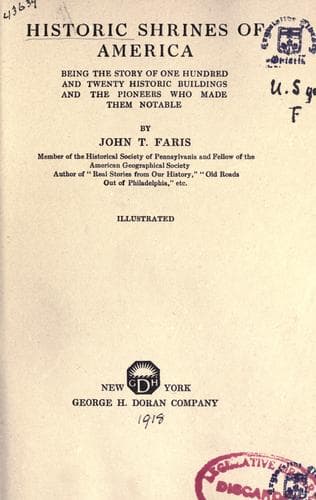
Historic Shrines of America: Being the Story of One Hundred and Twenty Historic Buildings and the Pioneers Who Made Them NotableFaris, John T. (John Thomson)
History
Historic Shrines of America: Being the Story of One Hundred and Twenty Historic Buildings and the Pioneers Who Made Them Notable
Faris, John T. (John Thomson)
Historic buildings -- United States; United States -- Biography
The time came when walks had to be taken on the veranda; health was
failing rapidly. He was not able to oversee the farm as he had long
been accustomed to do, but depended on others. In 1835 Mrs. Madison
wrote to her daughter: "My days are devoted to nursing and comforting
my sick patient, who walks only from the bed in which he breakfasts to
another." Still later she wrote: "I never leave my husband more than a
few minutes at a time, and have not left the enclosure around our
house for the last eight months."
When the owner of Montpelier died, on June 28, 1836, he was buried in
the cemetery on the estate. Mrs. Madison spent a few lonely years in
the old home, but the property was finally sold to satisfy the debts
of her wayward son, Payne Todd. She was sometimes in actual want
before she died, but Congress provided for her relief by buying for
twenty-five thousand dollars the Madison letters and other papers.
She lived until July 12, 1849, and her body was finally laid by the
side of that of her husband.
William Dupont, the present owner of Montpelier, has enlarged the
house by the addition of a second story to the wings. So the house
that was built in 1760 by James Madison, Sr., and was enlarged by
James Madison, Jr., has entered on a new era of hospitality.
LXVIII
OAK HILL, LOUDOUN COUNTY, VIRGINIA
THE HOME OF JAMES MONROE'S OLD AGE
James Monroe, at twenty-eight, wrote from New York to Thomas
Jefferson, with whom he had studied law:
"I shall leave this about the 1st of October for
Virginia--Fredericksburg. Believe me, I have not relinquished
the prospect of being your neighbor. The house for which I
have requested a plan may possibly be erected near
Monticello; to fix there, and to have yourself in particular,
with what friends we may collect around, for society is my
chief object; or rather, the only one which promises to me,
with the connection I have formed, real and substantial
pleasure; if, indeed, by the name of pleasure it may be
called."
The "connection" of which the future President wrote was his marriage
to Miss Eliza Kortwright of New York. Of this he had spoken in an
earlier letter to Jefferson:
"You will be surprised to hear that I have formed the most
interesting connection in human life with a young lady in
this town, as you know my plan was to visit you before I
settled myself, but having formed an attachment to this
young lady ... I have found that I must relinquish all other
objects not connected with her."
Public-domain text, read in full here on John Shaqi.
Reviews
Reviews
No reviews yet
Be the first to share your thoughts on this work.
Elsewhere in the archive
Join the Discussion
Join the discussion
Sign in to leave a comment or review.
Sign InorCreate an account