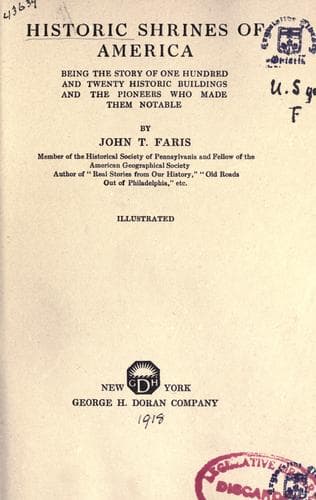
Historic Shrines of America: Being the Story of One Hundred and Twenty Historic Buildings and the Pioneers Who Made Them NotableFaris, John T. (John Thomson)
History
Historic Shrines of America: Being the Story of One Hundred and Twenty Historic Buildings and the Pioneers Who Made Them Notable
Faris, John T. (John Thomson)
Historic buildings -- United States; United States -- Biography
There were many guests at Oak Hill, among these being Madison and
Jefferson. Monroe, in turn, was frequently at Monticello and
Montpelier. His office as Regent of the University of Virginia also
brought him into frequent touch with his two predecessors in the
presidency, for they were fellow-members on the Board.
Whenever weather and guests permitted he was accustomed to ride about
the estate and through the countryside both morning and evening. One
day, when he was seventy-two, his horse fell on him, and his right
wrist was sprained so badly that for a time he could not write to his
friends, as he had delighted to do. Thus he was able to sympathize
with Madison when a letter came from Montpelier a few months later:
"In explanation of my microscopic writing, I must remark that
the older I grow the more my stiffening fingers make smaller
letters, as my feet take shorter steps, the progress in both
cases being, at the same time, more fatiguing as well as more
slow."
Monroe's last years of life were saddened by financial difficulties,
though even these brought gleams of joy, because of the fidelity of
his friends. Lafayette, who visited Oak Hill in 1825, wrote later to
his friend a most delicately worded offer of assistance, indicating
that he felt it was his right to offer this, since Monroe, when
minister to France, had exerted himself to bring about the release of
Lafayette, then a prisoner at Olmuetz, and had ministered to the wants
of Madame Lafayette.
A measure of relief came when Congress voted to repay, in part, the
extraordinary expense incurred by the statesman during his diplomatic
career, but not before he had advertised Oak Hill for sale and had
planned to go to New York to live near his daughter. The estate was
later withdrawn from the market, but the plan to go to New York was
carried out: he did not see how he could remain after the death of
Mrs. Monroe, which took place in 1830.
He did not stay long in New York. On July 4, 1831, he died.
Twenty-seven years later, on the one hundredth anniversary of his
birth, his body was taken to Richmond for burial. There, in his native
State, rest the remains of him of whom Thomas Jefferson said, "He is
a man whose soul might be turned inside out without discovering a
blemish to the world."
LXIX
RED HILL, CHARLOTTE COUNTY, VIRGINIA
WHERE PATRICK HENRY SPENT HIS LAST YEARS
Patrick Henry was only fifty-eight years old when he retired for rest
and the enjoyment of family life to his 2,920-acre estate, Red Hill,
in the Staunton Valley, thirty-eight miles southeast of Lynchburg.
Just before he made this move he wrote to his daughter Betsy, "I must
give out the law, and plague myself no more with business, sitting
down with what I have. For it will be sufficient employment to see
after my little flock."
Public-domain text, read in full here on John Shaqi.
Reviews
Reviews
No reviews yet
Be the first to share your thoughts on this work.
Elsewhere in the archive
Join the Discussion
Join the discussion
Sign in to leave a comment or review.
Sign InorCreate an account