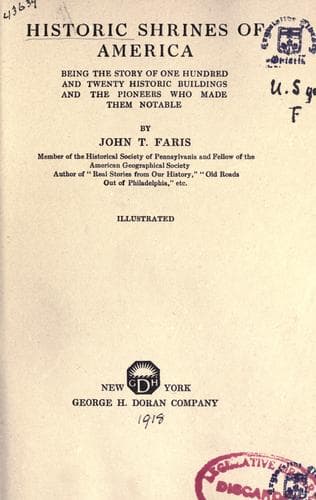
Historic Shrines of America: Being the Story of One Hundred and Twenty Historic Buildings and the Pioneers Who Made Them NotableFaris, John T. (John Thomson)
History
Historic Shrines of America: Being the Story of One Hundred and Twenty Historic Buildings and the Pioneers Who Made Them Notable
Faris, John T. (John Thomson)
Historic buildings -- United States; United States -- Biography
When Thomas Jefferson retired from the Presidency he was surrounded at
Monticello by his daughter, her husband, and eleven grandchildren.
Daily association with the young people made him more anxious than
ever to carry out a plan that was the growth of years. He wanted to
see other children as happy as were those in his own home, and he felt
that the one thing he could do to increase their happiness would be to
see that the State made provision for their education.
During the remainder of his life he never lost sight of his project.
While he did not live to see his system of common schools established
in Virginia, it was his joy to see the University of Virginia grow
under his hands from an academy to a college and then to a university.
From 1817 he labored for State appropriations for the school. A friend
in the State Senate assisted him nobly. The reader of the published
volume of the correspondence between the two men, a volume of 528
pages, will see how untiring was the labor that had its reward when
the appropriation of funds made sure the founding of the university.
Three hundred thousand dollars were provided for construction, as well
as $15,000 a year for maintenance.
Jefferson himself drew the plans for the buildings and superintended
the construction. Sarah N. Randolph, in "The Domestic Life of Thomas
Jefferson," says that "the architectural plan and form of government
and instruction for this institution afforded congenial occupation for
his declining years.... While the buildings were being erected, his
visits to them were daily; and from the northeast corner of the
terrace at Monticello he frequently watched the workmen engaged on
them, through a telescope which is still [1871] preserved in the
library of the University."
Edmund Bacon, the overseer at Monticello, gave to Hamilton W. Pierson,
the author of "Jefferson at Monticello," a humorous account of the
early days of the project:
"The act of the Legislature made it the duty of the
Commissioners to establish the University within one mile of
the Court House at Charlottesville. They advertised for
proposals for a site. Three men offered sites. The
Commissioners had a meeting at Monticello, and then went and
looked at all these sites. After they had made their
examination, Mr. Jefferson sent me to each of them, to
request them to send by me their price, which was to be
sealed up. Lewis and Craven each asked $17 per acre, and
Perry, $12. That was a mighty big price in those days....
They took Perry's forty acres, at $12 per acre. It was a poor
old turned-out field, though it was finely situated. Mr.
Jefferson wrote the deed himself. Afterwards Mr. Jefferson
bought a large tract near it. It had a great deal of timber
and rock on it, which was used in building the University.
Public-domain text, read in full here on John Shaqi.
Reviews
Reviews
No reviews yet
Be the first to share your thoughts on this work.
Elsewhere in the archive
Join the Discussion
Join the discussion
Sign in to leave a comment or review.
Sign InorCreate an account