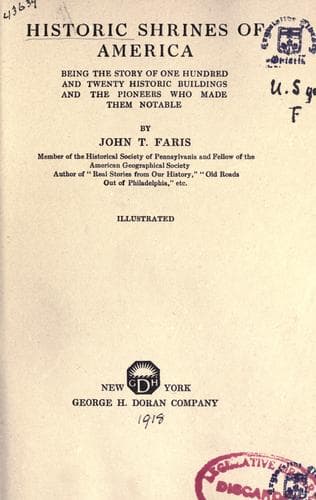
Historic Shrines of America: Being the Story of One Hundred and Twenty Historic Buildings and the Pioneers Who Made Them NotableFaris, John T. (John Thomson)
History
Historic Shrines of America: Being the Story of One Hundred and Twenty Historic Buildings and the Pioneers Who Made Them Notable
Faris, John T. (John Thomson)
Historic buildings -- United States; United States -- Biography
"My next instruction was to get ten able-bodied hands to
commence the work.... Mr. Jefferson started from Monticello
to lay off the foundation, and see the work commenced. An
Irishman named Dinsmore, and I, went along with him. As we
passed through Charlottesville, I ... got a ball of twine,
and Dinsmore found some shingles and made some pegs.... Mr.
Jefferson looked over the ground some time, and then stuck
down a peg.... He carried one end of the line, and I the
other, in laying off the foundation of the University. He had
a little ruler in his pocket that he always carried with him,
and with this he measured off the ground, and laid off the
entire foundation, and then set the men at work."
This foot-rule was shown to Dr. Pierson by Mr. Bacon, who explained
how he secured it:
"Mr. Jefferson and I were once going along the bank of the
canal, and in crawling through some bushes and vines, it
[the ruler] fell out of his pocket and slid down the bank
into the river. Some time after that, when the water had
fallen, I went and found it, and carried it to Mr. Jefferson.
He told me I ... could keep it.... When I die, that rule can
be found locked up in that drawer.
"After the foundations were nearly completed, they had a
great time laying the corner-stone. The old field was covered
with carriages and people. There was an immense crowd there.
Mr. Monroe laid the corner-stone. He was President at that
time.... He held the instruments, and pronounced it square. I
can see Mr. Jefferson's white head just as he stood there and
looked on.
"After this he rode there from Monticello every day while the
University was building, unless the weather was very
stormy.... He looked after all the materials, and would not
allow any poor materials to go into the building if he could
help it."
A letter from Jefferson to John Adams, written on October 12, 1823,
spoke of the "hoary winter of age." "Against this _tedium vitae_," he
said, "I am fortunately mounted on a hobby, which, indeed, I should
have better managed some thirty or forty years ago; but whose easy
amble is still sufficient to give exercise and amusement to an
octogenary rider. This is the establishment of a University, on a
scale more comprehensive, and in a country more healthy and central
than our old William and Mary, which these obstacles have long kept in
a state of languor and inefficiency."
In designing the buildings Jefferson acknowledged his indebtedness to
Palladio, who guided him in his adaptation of Roman forms. The visitor
who is familiar with Rome is reminded of the baths of Diocletian, the
baths of Caracalla, and the temple of Fortuna Virilis, while a
reduction of the Pantheon, with a rotunda, is the central feature of
the group.
Public-domain text, read in full here on John Shaqi.
Reviews
Reviews
No reviews yet
Be the first to share your thoughts on this work.
Elsewhere in the archive
Join the Discussion
Join the discussion
Sign in to leave a comment or review.
Sign InorCreate an account