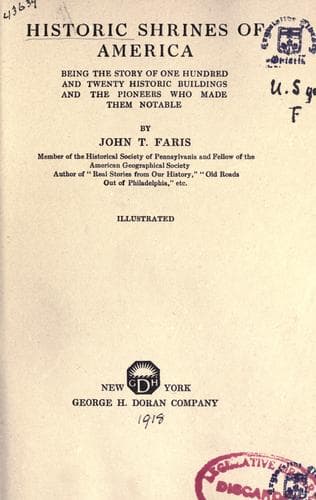
Historic Shrines of America: Being the Story of One Hundred and Twenty Historic Buildings and the Pioneers Who Made Them NotableFaris, John T. (John Thomson)
History
Historic Shrines of America: Being the Story of One Hundred and Twenty Historic Buildings and the Pioneers Who Made Them Notable
Faris, John T. (John Thomson)
Historic buildings -- United States; United States -- Biography
The clear-toned bells, which were cast in London in 1757, were taken
from the tower when the British evacuated the city in 1782, and were
sold in London as spoils of war. Fortunately a Mr. Ryhiner, once a
merchant in Charleston, learned of this, bought them, and sent them to
Charleston as a business venture.
When the bells were landed on the wharf from the brig _Lightning_, on
November 20, 1783--according to Johnson's "Traditions of
Charleston"--"the overjoyed citizens took possession, and hurried them
up to the church and into the steeple, without thinking that they
might be violating a private right." In June, 1785, Mr. Ryhiner asked
for payment for the bells. Later a subscription was ordered to pay the
merchant.
During the British occupation of the city horses were stabled in the
church, and the lead roof was removed, for use in bullet making.
In 1811 and 1812 the church figured in the second war with Great
Britain. The vestry, whose patriotism was as great as ever, opened the
building more than once for meetings of the citizens who wished to
consider what they could do to help their country in the impending
conflict.
During the Civil War the bells were taken to Columbia, to be cast into
cannon. Fortunately they were not used for this purpose, but during
Sherman's march to the sea they were burned and broken into small
pieces. A friend of the church in London, on learning of the disaster,
searched records of the bell-founders till he learned who had cast the
bells. These records told the proportions of metal used and the sizes
of the bells. Then the Londoner wrote to Charleston and asked that the
fragments be sent to him. When these were received in London they were
recast in the original moulds, which were discovered by an old
employee. The cost of recasting the bells and restoring them to their
places in the steeple was $7,723, of which sum the City Council
contributed $3,000; $2,200, the charge made for import duty, was later
returned to the church by special Act of Congress.
For nearly twenty years after the receipt of these new-old bells,
they were used to sound fire-alarms, as well as for calling to the
services of the church.
The venerable building has suffered from fire, wind, and earthquake,
as well as from war. In 1825 a cyclone damaged the spire and the roof,
and in 1886 earthquake cracked the walls, destroyed a portion of the
tower, and did so much further damage that a Charleston paper spoke of
it as the "saddest wreck of all." At first it was feared that the
building would have to be demolished, but repairs were found to be
possible at a cost of $15,000.
The structure dates from 1752, when Governor Glenn of South Carolina
laid the corner stone. The cost was $32,775.87.
Public-domain text, read in full here on John Shaqi.
Reviews
Reviews
No reviews yet
Be the first to share your thoughts on this work.
Elsewhere in the archive
Join the Discussion
Join the discussion
Sign in to leave a comment or review.
Sign InorCreate an account