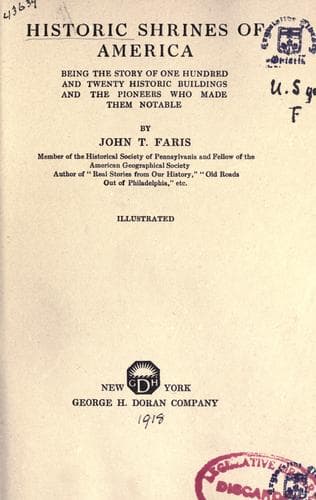
Historic Shrines of America: Being the Story of One Hundred and Twenty Historic Buildings and the Pioneers Who Made Them NotableFaris, John T. (John Thomson)
History
Historic Shrines of America: Being the Story of One Hundred and Twenty Historic Buildings and the Pioneers Who Made Them Notable
Faris, John T. (John Thomson)
Historic buildings -- United States; United States -- Biography
St. Michael's parish was set off in 1751 from St. Philip's parish. The
first St. Philip's Church was burned in 1681 or 1682. A second church
was opened in 1723. This famous building survived until 1835, in spite
of wars and fires. The building was saved during the fire of 1796 by a
slave who climbed to the tower and threw to the ground a burning
brand. As a reward the vestry purchased his freedom. But during the
great fire of February 15, 1835, the edifice was destroyed.
The old church had been so much a part of the life of the city and was
so thoroughly identified with the history of the country, that the
citizens rejoiced when the decision was reached to rebuild it in
practically every detail like the original, with the addition of a
chancel and spire.
Older than either St. Philip's or St. Michael's, as an organization,
is the Huguenot Church of Charleston. The early records of the
congregation were destroyed in the fire of 1740, though the building
was saved. This first building was blown up during the fire of 1796,
in a vain effort to stay the progress of the conflagration. A second
building followed in 1800, and the present building was erected in
1828, when English displaced the French language in the services.
Many of the early members became famous in history. The tablets
erected to their memory are so numerous that the Huguenot Church might
well dispute with St. Philip's Church the title, "The Westminster of
South Carolina."
[Illustration: PRINGLE HOUSE, CHARLESTON, S. C.
_Photo by H. P. Cook_
See page 336]
LXXVI
THE HOUSE OF REBECCA MOTTE, CHARLESTON, SOUTH CAROLINA
THE SPARTAN MATRON WHO HELPED BURN HER OWN PROPERTY
Charleston, South Carolina, was only about thirty years old when the
Englishman, Robert Brewton, and the Huguenot exile, John de la Motte,
took up their residence there. In 1758 Robert Brewton's daughter
Rebecca married Jacob Motte, grandson of the Huguenot.
Three daughters came to the Motte home, and the family lived quietly
until the outbreak of the Revolution. In 1775 Mrs. Motte's brother,
Miles Brewton, sailed for England with his family, intending to leave
them with relatives there while he returned to Charleston for the
service of his country. But the vessel was lost, and was never
heard from again. His Charleston house on King Street, which was built
about 1765, became the property of his sister.
When the war broke out, Mrs. Motte, knowing that it was impossible for
her husband to become a soldier because of his failing health, decided
to do her part for her country. Fortifications were to be built, and
many laborers were needed, so she sent to her plantation for all the
able-bodied men; these she placed at the disposal of those in charge
of the work of defence.
Public-domain text, read in full here on John Shaqi.
Reviews
Reviews
No reviews yet
Be the first to share your thoughts on this work.
Elsewhere in the archive
Join the Discussion
Join the discussion
Sign in to leave a comment or review.
Sign InorCreate an account