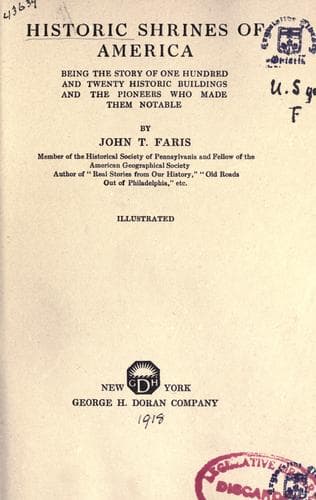
Historic Shrines of America: Being the Story of One Hundred and Twenty Historic Buildings and the Pioneers Who Made Them NotableFaris, John T. (John Thomson)
History
Historic Shrines of America: Being the Story of One Hundred and Twenty Historic Buildings and the Pioneers Who Made Them Notable
Faris, John T. (John Thomson)
Historic buildings -- United States; United States -- Biography
She had her reward when, first in 1776, and again in 1779, the British
forces were unable to secure possession of the town. The third
attempt, made by Sir Henry Clinton in 1780, was successful. For nearly
three years the town was in the enemy's control. The Motte house was
made headquarters by Clinton and his staff. The Mottes were crowded
into a small room, while the British lived in comfort in the large
apartments. Mrs. Motte divided her time between her invalid husband,
her timid daughters, and the invaders. It was her custom to preside at
the long dinner table, but the young ladies were never allowed to
appear in the presence of the officers.
A reminder of the presence of the unwelcome guests is still to be seen on
the marble mantel in one of the rooms--a caricature of Clinton scratched
on the polished surface, evidently with a diamond point. In the same
room the women of Charleston--who were accustomed to go about the
streets in mourning, during the period of the occupation--presented a
petition to Lord Rawdon, asking for the pardon of Isaac Hayne, a
patriot who had been condemned for some infraction of the regulations
of the invaders. Their petition for clemency was in vain, though it
was emphasized by the presence of Hayne's two little children.
After the death of Mr. Motte, in January, 1781, Mrs. Motte and her
daughters secured permission to leave Charleston that they might
return to the family plantation on the Congaree, thirty or forty miles
from Columbia. They were disappointed in their desire to be alone, for
it was not long till the English decided to build on the estate one of
their long line of military stations. Earthworks were thrown up around
the house, which became known as Fort Motte. Again the family were
crowded into a few rooms, while officers occupied the remainder.
After a time Mrs. Motte was asked to retire to a small house on the
plantation, a rough structure, covered with weather-boards,
unplastered and only partially lined. At first it seemed that there
was no place here to conceal the silverware brought from Fort Motte.
How the difficulty was solved has been told in "Worthy Women of Our
First Century":
"Some one suggested that the unfinished state of the walls of
their sitting-room afforded a convenient hiding place; and
they set to work to avail themselves of it. Nailing tacks in
the vacancy between the outer and inner boarding, and tying
strings around the various pieces of silver, they hung them
along the inner wall. Shortly afterwards a band of marauders
did actually invade the premises; and one more audacious than
the others jumped on a chair and thrust his bayonet into the
hollow wall, saying he would soon find what they had come in
search of; but, rapping all along on the floor within the
wall, he did not once strike against anything to reward bad
perseverance."
Public-domain text, read in full here on John Shaqi.
Reviews
Reviews
No reviews yet
Be the first to share your thoughts on this work.
Elsewhere in the archive
Join the Discussion
Join the discussion
Sign in to leave a comment or review.
Sign InorCreate an account