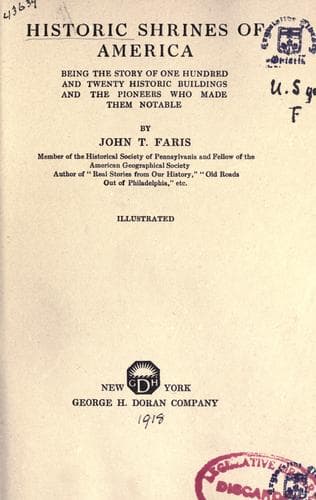
Historic Shrines of America: Being the Story of One Hundred and Twenty Historic Buildings and the Pioneers Who Made Them NotableFaris, John T. (John Thomson)
History
Historic Shrines of America: Being the Story of One Hundred and Twenty Historic Buildings and the Pioneers Who Made Them Notable
Faris, John T. (John Thomson)
Historic buildings -- United States; United States -- Biography
When George II, of his "special Grace, certain knowledge and meer
motion," gave a deed for a lot in Savannah, "in our province of
Georgia," he declared that it was "for the use and benefit of such of
our loving subjects ... as are or shall be professors of the Doctrines
of the Church of Scotland, agreeable to the Westminster Confession of
Faith." The further stipulation was made that the annual rent, if
demanded, should be "one pepper corn."
The date of the grant was January 16, 1756, and within the three years
allowed for the erection of the building a brick structure was ready
for the use of the Independent Presbyterian Church. The church was
independent in fact as well as in name. There was at first no
presbytery in Georgia with which it could unite, and when a presbytery
was organized, this independent relation continued.
The first pastor was Rev. John Joachim Zubly, who came to the Colonies
from Switzerland. He remained with the church until 1778, and became a
prominent figure among the patriots of the early years of the
Revolution. When the first Provincial Congress of Georgia met in
Savannah, July 4, 1775, it adjourned, immediately after organization,
to the Independent Church, where Dr. Zubly preached a sermon for which
he received the public thanks of Congress.
_The London Magazine_ for January, 1776, contained an impassioned
appeal for the Colonies, which was signed by Dr. Zubly. The editor
stated that the communication was printed at the request of "an old
correspondent," who signed himself "O." It is supposed that this
correspondent was General James E. Oglethorpe, the founder of Georgia.
A few months later Dr. Zubly went to Philadelphia, as a member of the
second Continental Congress. He had also been a member of the first
Congress in 1774.
During the siege of Savannah by the British the church building was
badly injured by British cannon, in spite of the fact that it was used
as a hospital. Later the British used the church as barracks. A
visitor who entered the city in 1784 said that he found the church in
a ruinous condition. It was promptly repaired, however, and services
were resumed.
But there was another pastor in the pulpit. In 1778 Dr. Zubly
resigned, probably because, for some strange reason, he deserted the
Colonies and made known his allegiance to Great Britain.
Public-domain text, read in full here on John Shaqi.
Reviews
Reviews
No reviews yet
Be the first to share your thoughts on this work.
Elsewhere in the archive
Join the Discussion
Join the discussion
Sign in to leave a comment or review.
Sign InorCreate an account