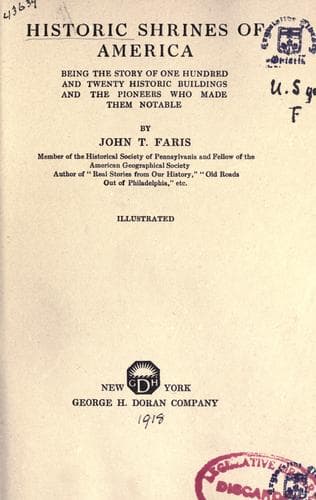
Historic Shrines of America: Being the Story of One Hundred and Twenty Historic Buildings and the Pioneers Who Made Them NotableFaris, John T. (John Thomson)
History
Historic Shrines of America: Being the Story of One Hundred and Twenty Historic Buildings and the Pioneers Who Made Them Notable
Faris, John T. (John Thomson)
Historic buildings -- United States; United States -- Biography
Fire destroyed the original building in 1796, and a fine new church
was built. Twenty-one years later the rapidly increasing congregation
made necessary a much larger structure. The new church was modelled
after St. Martin's-in-the-Fields, London, and more than two years were
required for its construction. The cost was $96,108.67-1/2, a large sum
for that day in a town of ten thousand people. Although the middle
aisle was eleven feet wide and each of the side aisles four and a half
feet wide, there were seatings for 1,350 people. The beautifully
proportioned steeple was 223 feet high. The day after the dedication a
local paper said that "for grandeur of design and nature of execution,
we presume this church is not surpassed by any in the United States."
Many architectural writers have told rapturously of the wonders of
this building.
President James Monroe and his suite, as well as many other
distinguished visitors, were reverent worshippers in the church on the
day of dedication.
Lowell Mason, who was organist of the church from 1815 to 1827,
composed the popular melody to which Bishop Heber's missionary hymn,
"From Greenland's Icy Mountains," is usually sung. This melody was
first played by him for the Sunday school of the church, whose
organization dates from 1804.
Dr. S. K. Axson, the grandfather of Ellen Axson, the first wife of
President Woodrow Wilson, was pastor of the church from 1857 to 1889.
The Wilson marriage ceremony was performed by Dr. Axson in the manse
of the church.
All Savannah mourned when, on April 6, 1889, firebrands tossed by the
wind lodged on a cornice of the graceful steeple, too high to be
reached. Soon the old church was in ruins. But the city resolved that
the historic church must be restored. A new building was erected which
is an exact reproduction of the former church. To it, as to its
predecessors, ecclesiastical architects go on pilgrimage as a part of
their education.
One of the old customs still continued in the church is the assembling
of the communicants at a table which is laid the entire length of the
broad aisle, as well as in the transept aisle.
[Illustration: THE CABILDO, NEW ORLEANS, LA.
_Photo by Ph. B. Wallace_
See page 343]
LXXVIII
THE CABILDO OF NEW ORLEANS
WHICH SAW THE TRANSFER OF LOUISIANA TO THE UNITED STATES
Public-domain text, read in full here on John Shaqi.
Reviews
Reviews
No reviews yet
Be the first to share your thoughts on this work.
Elsewhere in the archive
Join the Discussion
Join the discussion
Sign in to leave a comment or review.
Sign InorCreate an account