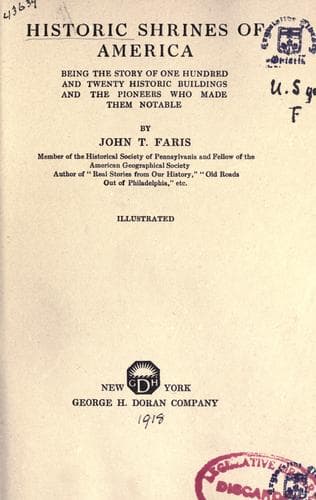
Historic Shrines of America: Being the Story of One Hundred and Twenty Historic Buildings and the Pioneers Who Made Them NotableFaris, John T. (John Thomson)
History
Historic Shrines of America: Being the Story of One Hundred and Twenty Historic Buildings and the Pioneers Who Made Them Notable
Faris, John T. (John Thomson)
Historic buildings -- United States; United States -- Biography
General Jackson was popular with all in the neighborhood of the
plantation. To his slaves he was a hero. To his wife he was devoted.
Parton says that he always treated her as if she was his pride and
glory. And words can faintly describe her devotion to him. She also
was popular among the servants; her treatment of them was courteous in
the extreme. A visitor to the Hermitage told of being present at the
hour of evening devotions. Just before these began the wife of the
overseer came into the room. Mrs. Jackson rose and made room for her
on the sofa. One of the guests expressed her surprise to a lady
sitting next her. "That is the way here," the lady whispered, "and if
she had not done it, the General would."
Peter Cartwright, the famous pioneer preacher, told in his
Autobiography an incident that revealed the General's nature.
Cartwright was preaching, when the pastor of a church, who was with
him in the pulpit, leaned forward and whispered, "General Jackson has
just come in." The outspoken preacher replied, so that every one could
hear: "What is that if General Jackson has come in? In the eyes of God
he is no bigger than any other man!" After the service Jackson told
Mr. Cartwright of his hearty approval of the sentiment.
That there might be more room for entertaining passing strangers like
Mr. Cartwright, as well as hosts of friends, Jackson began to build
The Hermitage in 1819, of brick made on the plantation. When this
house was burned in 1836, a new house was built on the old foundation,
and with the same general plan. The building has the rather unusual
length of 104 feet. Six pillars support the roof in front and in rear.
Between the building of the first house and its successor came most of
Jackson's political career. During this period also was the visit of
General Lafayette. On this occasion the Frenchman, recognizing the
pair of pistols which he had given to Washington in 1778, said that he
had a real satisfaction in finding them in the hands of one so worthy
of possessing them. "Yes, I believe myself to be worthy of them,"
Jackson began his reply, in words that seemed far less modest than the
conclusion proved them; for he added: "if not for what I have done, at
least for what I wished to do, for my country."
The Hermitage never seemed the same place to Jackson after the death
of his wife, on December 22, 1828, only a few days after his first
election to the presidency.
Two years after his final return from Washington, after attending
service at the little Presbyterian church on the estate, he begged the
pastor, Dr. Edgar, to return home with him. The pastor was unable to
accept, but promised to be on hand early in the morning. All night the
General read and prayed. Next morning, when Dr. Edgar came, he asked
to be admitted to the Church.
Public-domain text, read in full here on John Shaqi.
Reviews
Reviews
No reviews yet
Be the first to share your thoughts on this work.
Elsewhere in the archive
Join the Discussion
Join the discussion
Sign in to leave a comment or review.
Sign InorCreate an account