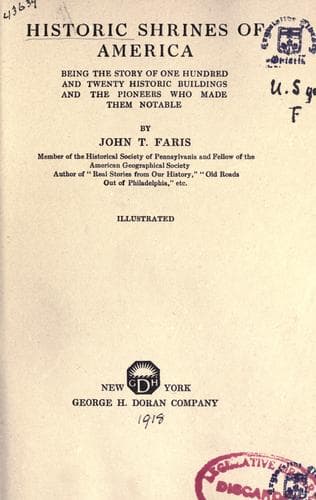
Historic Shrines of America: Being the Story of One Hundred and Twenty Historic Buildings and the Pioneers Who Made Them NotableFaris, John T. (John Thomson)
History
Historic Shrines of America: Being the Story of One Hundred and Twenty Historic Buildings and the Pioneers Who Made Them Notable
Faris, John T. (John Thomson)
Historic buildings -- United States; United States -- Biography
Parton says that from this time to the end of his life "General
Jackson spent most of his leisure hours in reading the Bible,
Biblical commentaries, and the hymn-book, which last he always
pronounced in the old-fashioned way, _hime_-book. The work known as
'Scott's Bible' was his chief delight; he read it through twice before
he died. Nightly he read prayers in the presence of his family and
household servants."
Soon after he united with the Church, the congregation wished to
choose him to the office of elder. "No," he said, "I am too young in
the Church for such an office. My countrymen have given me high
honors, but I should esteem the office of ruling elder in the Church
of Christ a far higher honor than any I have ever received."
For six years he continued to be an unofficial member of the church.
Then, on June 8, 1845, he said to those who had gathered about his
death-bed: "I am my God's. I belong to Him. I go but a short time
before you, and I want to meet you all, white and black, in heaven."
Less than two months before his death, when the President and
Directors of the National Institute proposed that an imported
sarcophagus in their possession be set apart for his last
resting-place, he declined, because he wished to lie by the side of
his wife, in the garden of The Hermitage.
Until 1888 Andrew Jackson, Jr., and after his death, his widow
occupied the house, during the last thirty-two years of this period as
caretakers for the State, which had bought the property for $48,000.
Since 1889 the mansion and twenty-five acres of ground have been cared
for by the Ladies' Hermitage Association.
[Illustration: ASHLAND, LEXINGTON, KY.
_Photo by E. C. Hall_
See page 355]
LXXXI
ASHLAND, LEXINGTON, KENTUCKY
THE HOME OF HENRY CLAY FOR FORTY-SIX YEARS
Henry Clay's mother, having married Captain Henry Watkins, moved from
Hanover, Virginia, to Woodford County, Kentucky, in 1792. As soon as
the future statesman was admitted to practice in the Virginia Court of
Appeals, he decided to follow her. Accordingly, in November, 1797, he
became a resident of Lexington. Three years later the _Kentucke
Gazette_, the first paper published west of the mountains, told of "an
eloquent oration" that was "delivered by Henry Clay, Esquire."
The year before the young lawyer received this flattering notice he
married Lavinia Hart, of Lexington. Seven years were spent in rented
quarters, but in 1806 he purchased an estate about a mile and a half
from town.
Clay took the keenest pleasure in the estate. Once he wrote to a
friend:
"I am in one respect better off than Moses. He died in sight
of and without reaching the Promised Land. I occupy as good a
farm as any he would have found had he reached it, and
'Ashland' has been acquired not by hereditary descent but by
my own labor."
Public-domain text, read in full here on John Shaqi.
Reviews
Reviews
No reviews yet
Be the first to share your thoughts on this work.
Elsewhere in the archive
Join the Discussion
Join the discussion
Sign in to leave a comment or review.
Sign InorCreate an account