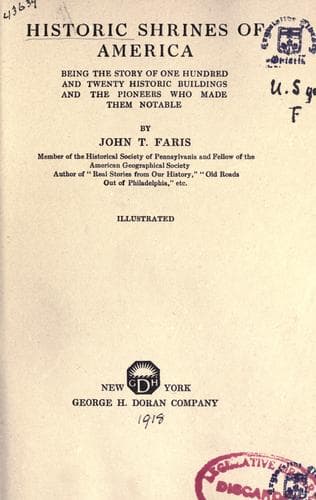
Historic Shrines of America: Being the Story of One Hundred and Twenty Historic Buildings and the Pioneers Who Made Them NotableFaris, John T. (John Thomson)
History
Historic Shrines of America: Being the Story of One Hundred and Twenty Historic Buildings and the Pioneers Who Made Them Notable
Faris, John T. (John Thomson)
Historic buildings -- United States; United States -- Biography
A story is also told of a bride and groom who visited Ashland on the
day the news of defeat was received. The journey was continued down
the Mississippi River. On the boat the groom was taken seriously ill.
The physician who was called to attend him was puzzled to define the
ailment until the bride said that the cause was the defeat of Henry
Clay. The old doctor threw his arms about the patient's neck and
cried, "There is no cure for a complaint like that."
The sting of defeat was forgotten one day in 1845. Mr. Clay was in his
bank in Lexington, prepared to pay a part of the indebtedness that had
all but swamped him, so that he felt he might have to sacrifice
Ashland. The bank told him that about $50,000 had been deposited in
the bank by his friends from all parts of the country, enough to pay
all his debts. He never knew the names of the generous friends who had
made possible the retention of the property.
He thought he was to spend the remainder of his days at home, and
that he would die there in peace. One day he said, in an address in
Lexington, "I felt like an old stag which has been long coursed by the
hunters and the hounds, through brakes and briars, and over distant
plains, and has at last returned to his ancient lair to lay himself
down and die."
Again in 1848 he tasted defeat, though on this occasion it was in the
nominating convention, not in the election. In the trying days that
followed he was sustained by his Christian faith. He had been baptized
in the parlor at Ashland on June 22, 1847. The reality of his
religious convictions was seen one day by what he said to a company of
friends who had been talking in a despairing manner of the future of
the country. Pointing to the Bible on the table, he said, "Gentlemen,
I do not know anything but that Book which can reconcile us to such
events."
In 1849 Clay was sent to the United States Senate because the
legislature of Kentucky felt that he was needed to help in the
solution of questions raised by the Mexican War. He spent three years
in Washington, then died in the midst of his work. After a journey
that showed what a place he had won in the hearts of the people, his
body was taken to Lexington. The catafalque lay in state in Ashland
over one night. Next day the body was buried near Lexington.
His son, James B. Clay, who purchased the estate at auction, tore down
the house because of its weakened foundations, but rebuilt it of the
same materials, on the old site, and on almost the identical plans.
Both outside and inside the mansion has practically the appearance of
the original.
Before the Civil War Ashland was purchased by the State College, but
in 1882 it became the property of Major Henry Clay McDowell, whose
widow lived there for many years. She was the daughter of Henry Clay,
Jr., whose death at the Battle of Buena Vista was a sore blow to one
who was always a fond father.
Public-domain text, read in full here on John Shaqi.
Reviews
Reviews
No reviews yet
Be the first to share your thoughts on this work.
Elsewhere in the archive
Join the Discussion
Join the discussion
Sign in to leave a comment or review.
Sign InorCreate an account