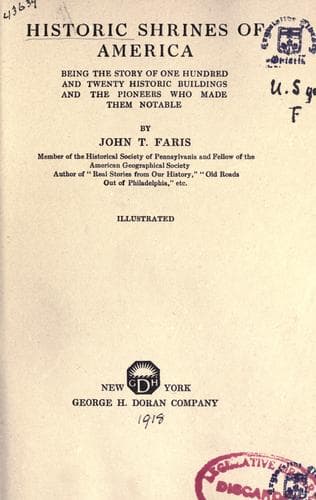
Historic Shrines of America: Being the Story of One Hundred and Twenty Historic Buildings and the Pioneers Who Made Them NotableFaris, John T. (John Thomson)
History
Historic Shrines of America: Being the Story of One Hundred and Twenty Historic Buildings and the Pioneers Who Made Them Notable
Faris, John T. (John Thomson)
Historic buildings -- United States; United States -- Biography
However, it was only at intervals that the proud owner was able to
enjoy Ashland. After 1803 the longest period of residence was six
years, and this was toward the close of his life.
The management of the property was largely in the hands of Mrs. Clay,
and the prosperity of the plantation was proof of her capability. From
Washington he wrote frequently of things he would like to see done. He
was especially interested in blooded stock which he secured in the
East and abroad. Once he wrote proudly of the fact that there were on
the estate specimens of "the Maltese ass, the Arabian horse, the
Merino and Saxe Merino sheep, the English Hereford and Durham cattle,
the goat, the mule and the hog." His race horses were famous, and he
delighted to handle them himself. He also liked to feed the pigs, even
when he was an old man.
There were many slaves at Ashland, and they were all attached to their
master. His will provided for their emancipation, under wise
conditions. Once, when a friend bequeathed him twenty-five slaves, he
sent them to Liberia, by way of New Orleans.
Harriet Martineau, who visited Ashland in 1835, told of her pleasant
impression of the place and its owner:
"I stayed some weeks in the house of a wealthy landowner in
Kentucky. Our days were passed in great luxury, and the
hottest of them very idly. The house was in the midst of
grounds gay with verdure and flowers, in the opening month of
June, and our favorite seats were the steps of the hall, and
chairs under the trees. From there we could watch the play of
the children on the grass plot, and some of the drolleries of
the little negroes.... There were thirty-three horses in the
stables, and we roved about the neighboring country
accordingly...."
As the years passed visitors flocked to Ashland in ever-increasing
numbers. Many of them were politicians, but more were plain people
who were devoted to Clay and could not understand why the country
refused to elect him President. In 1844, during his longest period of
continuous residence at Ashland, he received word of the disappointing
result of the election. After a few days, when he was walking on the
turnpike near the house, he was startled by a woman who, on passing
him, burst into tears. When he asked her why she wept, she said:
"I have lost my father, my husband, and my children, and
passed through other painful trials; but all of them together
have not given me so much sorrow as the late disappointment
of your friends."
Public-domain text, read in full here on John Shaqi.
Reviews
Reviews
No reviews yet
Be the first to share your thoughts on this work.
Elsewhere in the archive
Join the Discussion
Join the discussion
Sign in to leave a comment or review.
Sign InorCreate an account