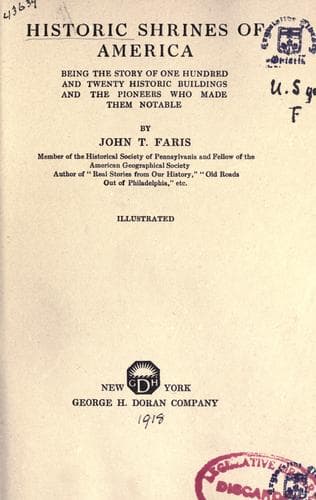
Historic Shrines of America: Being the Story of One Hundred and Twenty Historic Buildings and the Pioneers Who Made Them NotableFaris, John T. (John Thomson)
History
Historic Shrines of America: Being the Story of One Hundred and Twenty Historic Buildings and the Pioneers Who Made Them Notable
Faris, John T. (John Thomson)
Historic buildings -- United States; United States -- Biography
Lincoln longed for better quarters, however, because he wanted to be
married. He watched with interest the new buildings that were going
up, probably reflecting sadly that none of them were for him. In his
discouragement he wrote to Miss Mary Owen of New Salem, to whom he had
said something about coming to live with him in Springfield:
"You would have to be poor, without the means of hiding your
poverty. Do you believe you could bear that patiently?
Whatever woman may cast her lot with mine, should any ever do
so, it is my intention to do all in my power to make her
happy and contented. And there is nothing I can imagine that
would make me more unhappy than to fail in the effort. I know
I should be much happier with you than the way I am, provided
I saw no sign of discontent in you."
Miss Owen declined to go to Springfield, because she felt that Lincoln
was "deficient in those little links which make up the chain of a
woman's happiness."
Five years later, on November 4, 1842, Lincoln married Miss Mary Todd,
a member of a prominent Kentucky family, who had come to Springfield
in 1839 to live with her sister, Mrs. Ninian W. Edwards. The house in
which she spent the three years before her marriage was one of the
handsomest in the town, and was a centre of social gayety. Mr. and
Mrs. Edwards opposed the marriage to the poor and plebeian lawyer;
they urged the folly of exchanging a cultured home for the
surroundings to which Lincoln would take her. But she knew her own
mind, and she went with Lincoln to the home he provided for her.
The character of the accommodations to which he took his bride is
revealed by a letter written in May, 1843: "We are not keeping house,
but boarding at the Globe Tavern.... Boarding only costs four dollars
a week."
But the day came when the young statesman was able to open for Mrs.
Lincoln the door of their own modest one-story house. Later a second
story was added under the direction of his wife, most of the work
being done while he was away from home, riding the circuit.
J. G. Holland's pleasing picture of life in the home during the years
from 1850 to 1860 should be remembered:
Public-domain text, read in full here on John Shaqi.
Reviews
Reviews
No reviews yet
Be the first to share your thoughts on this work.
Elsewhere in the archive
Join the Discussion
Join the discussion
Sign in to leave a comment or review.
Sign InorCreate an account