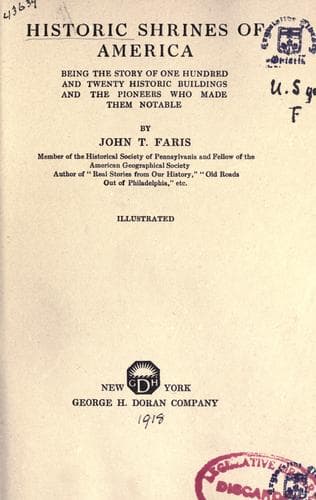
Historic Shrines of America: Being the Story of One Hundred and Twenty Historic Buildings and the Pioneers Who Made Them NotableFaris, John T. (John Thomson)
History
Historic Shrines of America: Being the Story of One Hundred and Twenty Historic Buildings and the Pioneers Who Made Them Notable
Faris, John T. (John Thomson)
Historic buildings -- United States; United States -- Biography
"It was to him a time of rest, of reading, of social
happiness, and of professional prosperity. He was already a
father, and took an almost unbounded delight in his children.
The most that he could say to any rebel in his household was,
'You break my heart, when you act like this.' A young man
bred in Springfield speaks of a vision that has clung to his
memory very vividly.... His way to school led by the lawyer's
door. On almost any fair summer morning he could find Mr.
Lincoln on the sidewalk in front of his house, drawing a
child backward and forward, in a child's gig. Without hat or
coat, and wearing a pair of rough shoes, his hands behind him
holding on to the tongue of the gig, and his tall form bent
forward to accommodate himself to the service, he paced up
and down the walk forgetful of everything around him. The
young man says he remembers wondering how so rough and plain
a man should live in so respectable a house."
Once Lincoln was sitting on the porch when three-year-old Willie
escaped from the bathtub, ran out cf the house and the gate, up the
street, and into a field. There his father caught him, and carried
him home on his shoulder.
The children liked to ride on his shoulder, and they clambered for the
position. If they could not get there, they contented themselves with
hanging to his coat tails. One day a neighbor heard the boys crying,
and asked what was the matter. "Just what's the matter with the whole
world," was Lincoln's reply. "I've got three walnuts, and each wants
two."
During the last day of the Republican Convention of 1860, which was in
session in Chicago, Lincoln was in the office of the Springfield
_Journal_, receiving word of the progress of events. A messenger came
in and said to him, "The Convention has made a nomination, and Mr.
Seward is--the second man on the list!" After reading the telegram,
and receiving the congratulations of all in the office, Lincoln spoke
of the little woman on Eighth Street who had some interest in the
matter, and said he would go home and tell her the news.
When the news became generally known, the citizens followed him to the
house on Eighth Street. In the evening, after a meeting in the State
House, the Republicans present marched to the Lincoln home. The
nominee made a speech, and invited as many as could get in to enter
the house. "After the fourth of March we will give you a larger
house," came the laughing response.
Next day Lincoln was in a quandary. Some of his friends had sent him a
present of wines and other liquors, that he might be able to give what
they thought would be appropriate refreshment to the Committee sent
from Chicago to notify the nominee. Before the formal notification,
Lincoln asked the members what he should do with the wine. J. G.
Holland says that "the chairman at once advised him to return the
gift, and to offer no stimulants to his guests."
Public-domain text, read in full here on John Shaqi.
Reviews
Reviews
No reviews yet
Be the first to share your thoughts on this work.
Elsewhere in the archive
Join the Discussion
Join the discussion
Sign in to leave a comment or review.
Sign InorCreate an account