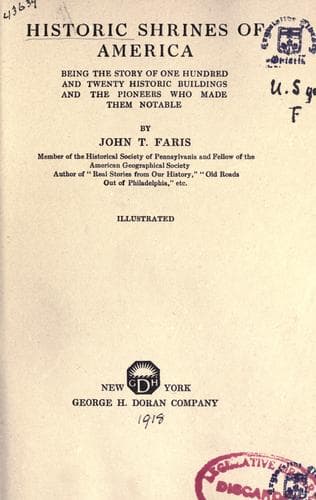
Historic Shrines of America: Being the Story of One Hundred and Twenty Historic Buildings and the Pioneers Who Made Them NotableFaris, John T. (John Thomson)
History
Historic Shrines of America: Being the Story of One Hundred and Twenty Historic Buildings and the Pioneers Who Made Them Notable
Faris, John T. (John Thomson)
Historic buildings -- United States; United States -- Biography
A few years later, when he had closed the house which he was never to
enter again, he said to his friends, who had gathered at the train to
say good-bye:
"My friends: no one, not in my situation, can appreciate my
feeling of sadness at this parting. To this place, and the
kindness of these people, I owe everything. Here I have lived
a quarter of a century, and have passed from a young to an
old man. Here my children have been born, and one is buried.
I now leave, not knowing when or whether ever I may return,
with a task before me greater than that which rested upon
Washington. Without the assistance of that Divine Being who
ever attended him, I cannot succeed. With that assistance I
cannot fail. Trusting in Him, who can go with me, and remain
with you, and be everywhere for good, let us confidently hope
that all will yet be well. To His care commending you, as I
hope in your prayers you will commend me, I bid you an
affectionate farewell."
When the body of the martyred President was brought back to
Springfield on May 3, 1865, it was not taken to the old home on Eighth
Street, but to the State Capitol, and from there to Oak Ridge
Cemetery.
The house is now the property of the State of Illinois, the gift of
Robert T. Lincoln, Abraham Lincoln's son.
[Illustration: WILLIAM HENRY HARRISON'S HOUSE, VINCENNES, IND.
_Photo furnished by Frank H. Curtis, Vincennes_
See page 376]
LXXXV
THE GOVERNOR'S PALACE AT VINCENNES, INDIANA
WHERE "OLD TIPPECANOE" WELCOMED HIS GUESTS
William Henry Harrison, son of Benjamin Harrison, one of the signers
of the Declaration of Independence, was a ward of Robert Morris. The
great financier opposed the young man's purpose to enlist in the Ohio
campaign against the Indians that followed the war of the Revolution,
but when young Harrison applied directly to Washington he was
appointed ensign and sent to the front. This was in 1791, and the new
ensign was but nineteen years old.
Gallant conduct during a campaign of four years under General Anthony
Wayne brought to him promotion to a captaincy, the favor of his
general, and the command of Fort Washington, at what is now
Cincinnati, Ohio.
This post was resigned in 1798, when there seemed no further prospect of
active service. Thereupon Washington appointed the twenty-four-year-old
captain Secretary of the Northwestern Territory and _ex officio_
Lieutenant Governor. When, in 1800, the Northwestern Territory was
divided, he was nominated by Thomas Jefferson Governor of Indiana
Territory, including what is now Indiana, Illinois, Michigan,
Wisconsin, and Iowa.
Public-domain text, read in full here on John Shaqi.
Reviews
Reviews
No reviews yet
Be the first to share your thoughts on this work.
Elsewhere in the archive
Join the Discussion
Join the discussion
Sign in to leave a comment or review.
Sign InorCreate an account