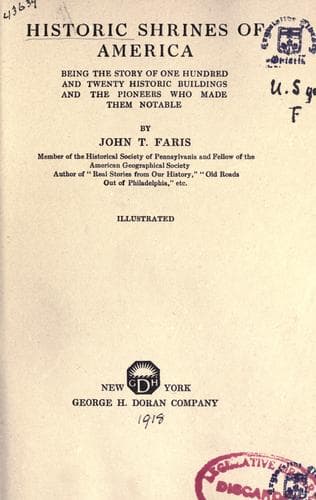
Historic Shrines of America: Being the Story of One Hundred and Twenty Historic Buildings and the Pioneers Who Made Them NotableFaris, John T. (John Thomson)
History
Historic Shrines of America: Being the Story of One Hundred and Twenty Historic Buildings and the Pioneers Who Made Them Notable
Faris, John T. (John Thomson)
Historic buildings -- United States; United States -- Biography
On the first floor a commodious hallway communicates on the left with
the Council Chamber, where notable visitors were received. This was
also the chamber of early territorial lawmakers. Here, in 1805, by
Rev. Thomas Clelland, was preached the first Presbyterian sermon in
what is now the State of Indiana.
In the shutter of a room facing the rear is the mark of a bullet
which, it is said, was fired by an Indian who was attempting the life
of the Governor, while that official was walking the floor with his
little son in his arms.
To-day the house is cut off from the city by railroad tracks and is
surrounded by factories. Until 1916 it was owned by the Vincennes
Water Company, which proposed to raze it to the ground, that they
might have room for extension. Learning of this purpose, six members
of the Francis Vigo Chapter of the Daughters of the American
Revolution begged the City Council to buy the house and preserve it.
When the Council announced that the way was not open to do this, a
number of patriotic women, led by Mrs. Frank W. Curtis, raised the sum
necessary for the purchase of the property.
Under the direction of the Francis Vigo Chapter, the house has been
restored, and opened for visitors. It is the intention to maintain it
for the inspiration of those who visit Vincennes to look on the scene
of the wise labors of the first Governor of the Indian Territory.
[Illustration: RUFUS PUTNAM'S HOUSE, MARIETTA, O.
_Photo furnished by Miss Willia D. Cotton, Marietta_
See page 377]
LXXXVI
THE HOUSE OF GENERAL RUFUS PUTNAM, MARIETTA, OHIO
THE MAN WHO LED THE FIRST PERMANENT SETTLERS TO OHIO
In 1775 General Washington decided that he must fortify Dorchester
Heights, Boston, if he was to force the British to leave the country.
But how was he to do this? The ground was frozen to a depth of
eighteen inches, and the enemy's cannon commanded the coveted
position. Lieutenant Colonel Putnam told the General that the
seemingly impossible task could be performed. Washington was dubious,
but he had learned that Colonel Putnam was to be counted on. One
night, after dark, the work was begun, and before daylight it was so
far completed that the surprised enemy were compelled to retire.
In recognition of services like this, Colonel Putnam was made a
brigadier general. A reward even greater was his; he won the lasting
friendship of Washington.
Eight years after the fortification of Dorchester Heights, two hundred
and eighty-three officers asked Congress for a grant of land in the
western country. General Putnam forwarded the petition to Washington,
and urged that it be granted, in order that "the country between Lake
Erie and the Ohio might be filled with inhabitants, and the faithful
subjects of the United States so established on the waters of the Ohio
and on the lakes as to banish forever the idea of our western
territory falling under the dominion of any European power."
Public-domain text, read in full here on John Shaqi.
Reviews
Reviews
No reviews yet
Be the first to share your thoughts on this work.
Elsewhere in the archive
Join the Discussion
Join the discussion
Sign in to leave a comment or review.
Sign InorCreate an account