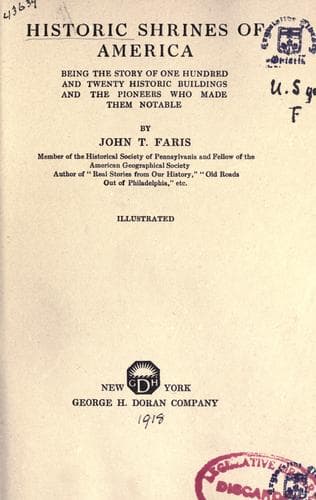
Historic Shrines of America: Being the Story of One Hundred and Twenty Historic Buildings and the Pioneers Who Made Them NotableFaris, John T. (John Thomson)
History
Historic Shrines of America: Being the Story of One Hundred and Twenty Historic Buildings and the Pioneers Who Made Them Notable
Faris, John T. (John Thomson)
Historic buildings -- United States; United States -- Biography
Action by Congress was delayed. On June 2, 1784, Washington wrote to
Putnam:
"I wish it was in my power to give you a more favorable
account of the officers' petition for lands on the Ohio and
its water, than I am about to do.... For surely if justice
and gratitude to the army, and general policy of the Union
were to govern in the case, there would not be the smallest
interruption in granting the request."
Putnam did not lose heart. His next step, taken in January, 1786, was
to call a meeting of officers and soldiers and others to form an Ohio
Company. The meeting was held at the Bunch of Grapes Tavern, in
Boston, March 1, 1786, and the Ohio Company of Associates was duly
formed. It was agreed to raise a fund to purchase from Congress, for
purposes of settlement, the western lands which Congress had been
asked to give them.
On July 27, 1787, a tract of 1,500,000 acres on the Ohio River,
between the Scioto and the Muskingum rivers, was sold to the Company
at sixty-six and two-thirds cents per acre. Half the amount was paid
down. When, later, it became impossible to pay the remainder, Congress
gave a measure of relief.
The first emigrants to go to the new lands set out from Danvers,
Massachusetts, December 1, 1787, under the guidance of General Rufus
Putnam, while a second party started from Hartford, Connecticut,
January 1, 1788. The first party of twenty-two men followed the Indian
trail over the Allegheny Mountains and reached the Youghiogheny River,
on January 23, 1788, while the second party of twenty-eight men,
making better time, joined them on February 14. Then a barge, called
the _Mayflower_, was built, forty-six feet long and twelve feet wide.
A cabin was provided for the women of the party, and an awning was
stretched. The men propelled the boat with ten oars.
On April 1 the voyage to the Ohio was begun, and on April 7 the party
reached the mouth of the Muskingum. The barge was moored to the bank,
opposite Fort Harmar. Thus came the Massachusetts pioneers to the town
of which Washington wrote later: "No colony in America was ever
settled under such favorable auspices as that which has just commenced
at Muskingum. Information, property, and strength will be its
characteristics. I know many of the settlers personally, and there
never were men better calculated to promote the welfare of such a
community."
Public-domain text, read in full here on John Shaqi.
Reviews
Reviews
No reviews yet
Be the first to share your thoughts on this work.
Elsewhere in the archive
Join the Discussion
Join the discussion
Sign in to leave a comment or review.
Sign InorCreate an account