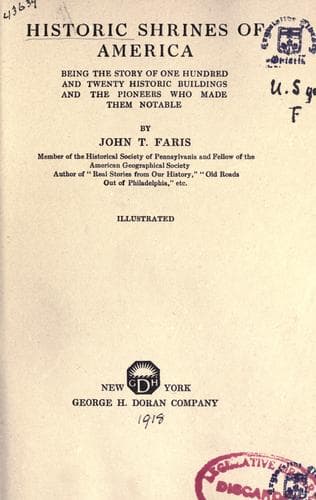
Historic Shrines of America: Being the Story of One Hundred and Twenty Historic Buildings and the Pioneers Who Made Them NotableFaris, John T. (John Thomson)
History
Historic Shrines of America: Being the Story of One Hundred and Twenty Historic Buildings and the Pioneers Who Made Them Notable
Faris, John T. (John Thomson)
Historic buildings -- United States; United States -- Biography
In 1759 came the end of French rule. General Prideaux's expedition
from New York began the siege of the fort early in July, and after
several weeks it capitulated. Until 1796 the English flag floated
above the "castle." The commander of this post, like the commanders of
six other forts, refused on various pretexts to surrender to America,
in spite of the terms of the treaty of 1783. Attempts were made to
secure possession, but none of them were successful, and it was not
until 1794 that Great Britain agreed to evacuate Niagara and the other
forts still held, "on or before the 1st of June, 1796."
Seventeen years later, in 1813, the British flag again replaced the
Stars and Stripes over the historic building, but the fort was
restored to the United States in 1815. Since that time it has been a
part of the army post that has been more important because of its
history than for any other reason.
The Daughters of the War of 1812 have placed a suitable tablet on the
Old Castle, and are interested in the proposition that has been made
to turn the venerable edifice into an international museum, which
shall commemorate the one hundred years of peace between Great Britain
and America.
In 1917 the eyes of the nation were once more turned on the fort by
Lake Ontario, for it was made a training ground for officers who were
to be sent to the battle front in France and Belgium. The castle,
nearly two hundred years old, and strong as ever, again witnessed the
gathering of patriots, and the spot that had echoed to the tread of
French who had yielded to the English, of English who had driven out
the French, and of Americans who had driven out the English, became
the parade ground of Americans who were making ready to stand side by
side with French and English for the freedom of the world.
[Illustration: THE SCHUYLER MANSION, ALBANY, N. Y.
_Photo furnished by Hon. Martin H. Glynn, Albany_
See page 391]
LXXXIX
THE SCHUYLER MANSION, ALBANY, NEW YORK
THE RALLYING PLACE OF THE CONSTITUTIONALISTS
When Catherine Van Rensselaer married Philip Schuyler, on September
17, 1755, he was a soldier who had been engaged in the campaign
against the French at Crown Point. She was glad when he resigned, in
1756, but he returned to army life in 1758 and at intervals for more
than twenty years he continued his military service. Two days after
the Battle of Bunker Hill Congress made him a major-general. During
his three years in the army of the Colonies, he was the subject of
continual abuse on the part of those who felt that he had conducted
carelessly his expedition to Canada and the campaign against Burgoyne.
He was able to stand up against the public clamor because Washington
had confidence in him and because he was twice given a clean bill of
health by a court of inquiry.
Public-domain text, read in full here on John Shaqi.
Reviews
Reviews
No reviews yet
Be the first to share your thoughts on this work.
Elsewhere in the archive
Join the Discussion
Join the discussion
Sign in to leave a comment or review.
Sign InorCreate an account