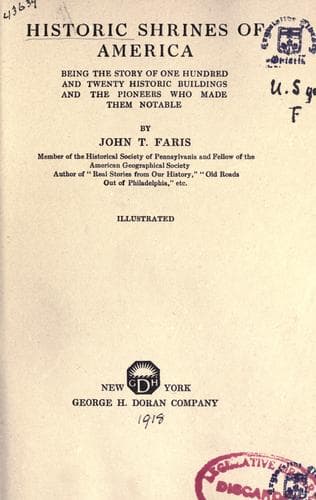
Historic Shrines of America: Being the Story of One Hundred and Twenty Historic Buildings and the Pioneers Who Made Them NotableFaris, John T. (John Thomson)
History
Historic Shrines of America: Being the Story of One Hundred and Twenty Historic Buildings and the Pioneers Who Made Them Notable
Faris, John T. (John Thomson)
Historic buildings -- United States; United States -- Biography
After the construction of the barques had been begun, the consent of
the five Iroquois nations was secured. Longueuil promised them that it
would be to them "a House of Peace" down to the third generation and
farther. To Gaspard Chaussegros de Lery, engineer, was committed the
building of the structure. He determined to make it fireproof.
"Instead of wooden partitions I have built heavy walls, and paved all
the floors with flat stone," he wrote in a report sent to France. The
loft was paved with flat stones "on a floor full of good oak joists,
upon which cannon may be placed above the structure."
The trade with the Indians at the completed stone house on the Niagara
increased. So did the activities of the English. Governor Burnet of
New York craftily persuaded the Onondaga Indians that their interests
had been endangered by the building of the French fort, since it
penned them up from their chief hunting-place, and was therefore
contrary to the Treaty of Utrecht; they agreed with him that the
Iroquois had no right to the territory, which was really the property
of the Senecas, and they asked the Governor to appeal to King George
to protect them in their right.
Therefore the suggestion was made that they "submit and give up all
their hunting country to the King," and sign a deed for it.
Accordingly Seneca, Cayuga, and Onondaga sachems deeded to the English
a sixty-mile strip along the south shore of Lake Ontario, which
included the Niagara frontier, the Niagara River being the western
boundary.
"From this time on the 'stone house' was on British soil; but it was
yet to take the new owner a generation to dispossess the obnoxious
tenant," Frank H. Severance writes in "An Old Frontier of France."
The story of the next thirty years is a story of plots and
counter-plots, of expeditions threatened and actual, of disappointing
campaigns, of imprisonment and cruelty and death. More than once
Indians promised the English that the house at Niagara should be
razed. Spies reported that the defences at the castle were in bad
shape; "'tis certain that, should the English once attack it, 'tis
theirs," one report ran. "I am informed that the fort is so
dilapidated that 'tis impossible to put a pin in it without causing it
to crumble; stanchions have been obliged to be set up against it to
support it." Another report disclosed that if the cannon were fired
the walls would crumble.
But the French were not ready to give up. They felt that Fort Niagara
was the key to the Ohio Valley, which they wished to control. They
strengthened the defences of the fort. The defeat of Braddock at Fort
Du Quesne and the strange decision of General Shirley to stop at
Oswego instead of continuing with his force to Niagara, gave the
French a new lease of life.
Public-domain text, read in full here on John Shaqi.
Reviews
Reviews
No reviews yet
Be the first to share your thoughts on this work.
Elsewhere in the archive
Join the Discussion
Join the discussion
Sign in to leave a comment or review.
Sign InorCreate an account