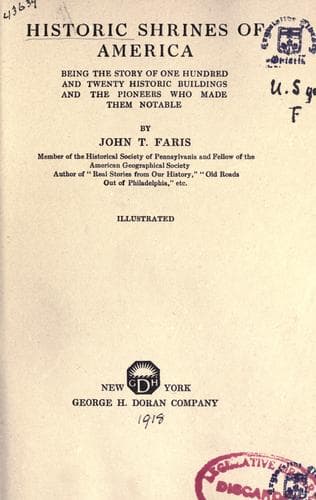
Historic Shrines of America: Being the Story of One Hundred and Twenty Historic Buildings and the Pioneers Who Made Them NotableFaris, John T. (John Thomson)
History
Historic Shrines of America: Being the Story of One Hundred and Twenty Historic Buildings and the Pioneers Who Made Them Notable
Faris, John T. (John Thomson)
Historic buildings -- United States; United States -- Biography
_The old house by the linden
Stood silent in the shade,
And on the gravelled pathway
The light and shadow played._
_I saw the nursery windows
Wide open to the air;
But the faces of the children,
They were no longer there._
_The large Newfoundland house-dog
Was standing by the door;
He looked for his little playmates
Who would return no more._
_They walked not under the linden,
They played not in the hall;
But shadow and silence, and sadness
Were hanging over all._
_The birds sang in the branches,
With sweet familiar tone;
But the voices of the children
Will be heard in dreams alone!_
_And the boy that walked beside me,
He could not understand
Why close in mine, ah! closer,
I pressed his little hand!_
When Henry Wadsworth Longfellow wrote these lines perhaps he was
thinking of the home of his boyhood in Portland, which his
grandfather, General Peleg Wadsworth, built in 1785.
The house was the wonder of the town, for it was the first brick
building erected there. The brick had been brought from Virginia.
Originally there were but two stories; the third story was added when
the future poet was eight years old.
Longfellow was born in the house at the corner of Fourth and Hancock
streets, but he was only eight months old when he was carried within
the inviting front doors of the Wadsworth house, and the mansion was
home to him for at least thirty-five years.
He was only five years old when he declared that he wanted to be a
soldier and fight for his country. The War of 1812 was then in
progress. His aunt wrote one day, "Our little Henry is ready to march;
he had his gun prepared and his head powdered a week ago."
But, agreeing with his parents that school was a better place for him
than the army, he began his studies when he was five years old. A year
later his teacher gave him a certificate which read:
"Master Henry Longfellow is one of the best boys we have in
school. He spells and reads very well. He also can add and
multiply numbers. His conduct last quarter was very correct
and amiable."
Life in the Longfellow home was delightful. Samuel Longfellow, the
poet's brother, has given a pleasing picture:
Public-domain text, read in full here on John Shaqi.
Reviews
Reviews
No reviews yet
Be the first to share your thoughts on this work.
Elsewhere in the archive
Join the Discussion
Join the discussion
Sign in to leave a comment or review.
Sign InorCreate an account