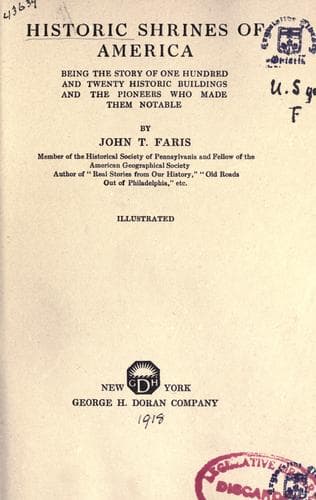
Historic Shrines of America: Being the Story of One Hundred and Twenty Historic Buildings and the Pioneers Who Made Them NotableFaris, John T. (John Thomson)
History
Historic Shrines of America: Being the Story of One Hundred and Twenty Historic Buildings and the Pioneers Who Made Them Notable
Faris, John T. (John Thomson)
Historic buildings -- United States; United States -- Biography
"In the evenings the children gathered with their books and
slates round the table in the family sitting room. The
silence would be broken for a minute by the long, mysterious
blast of a horn announcing the arrival in town of the evening
mail, then the rattle of its passing wheels, then silence
again, save the singing of the wood fire. Studies over, there
would be games till bedtime. If these became too noisy, or
the father had brought home his law papers from the office,
enjoining strictest quiet, then there was flight to another
room--perhaps, in winter, to the kitchen, where hung the
crane over the coals in the broad old fireplace, upon whose
iron back a fish forever baked in effigy.
"When bedtime came, it was hard to leave the warm fire to go
up into the unwarmed bedrooms; still harder next morning to
get up out of the comfortable feather beds and break the ice
in the pitchers for washing. But hardship made hardihood. In
summer it was pleasant enough to look out from the upper
windows; those of the boys' room looked out over the Cove and
the farms and woodlands toward Mount Washington, full in view
on the western horizon; while the eastern chambers commanded
a then unobstructed view of the bay, White Head, Port
Prebble, and the lighthouse on Cape Elizabeth."
One day in 1820, when the family was gathered about the fire, Henry
was on tiptoe with eager excitement. He had written a poem and had
sent it to The Portland _Gazette_. Would it be in the paper which his
father had in his hand as he seated himself before the fire?
Robertson, in his life of the poet, has described those anxious
moments:
"How carefully his father unfolded the damp sheet, and how
carefully he dried it at the fire ere beginning to read it!
And how much foreign news there seemed to be in it! At last
Henry and a sympathetic sister who shared his secret,
obtained a peep over their parent's shoulder--and the poem
was there!"
There are sixteen rooms in the old house. In Henry's day these rooms
were heated by eight fireplaces, which consumed thirty cords of wood
during the long winter. On the first floor are the great living-room,
the kitchen with its old fireplace, and the den, once the dining-room.
On the desk still shown in this room Longfellow wrote, in 1841, "The
Rainy Day," whose opening lines are:
"The day is cold, and dark, and dreary,
It rains, and the wind is never weary;
The vine still clings to the mouldering wall,
But at every gust the dead leaves fall,
And the day is dark and dreary."
Public-domain text, read in full here on John Shaqi.
Reviews
Reviews
No reviews yet
Be the first to share your thoughts on this work.
Elsewhere in the archive
Join the Discussion
Join the discussion
Sign in to leave a comment or review.
Sign InorCreate an account