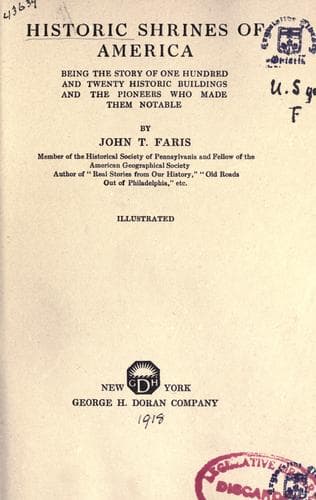
Historic Shrines of America: Being the Story of One Hundred and Twenty Historic Buildings and the Pioneers Who Made Them NotableFaris, John T. (John Thomson)
History
Historic Shrines of America: Being the Story of One Hundred and Twenty Historic Buildings and the Pioneers Who Made Them Notable
Faris, John T. (John Thomson)
Historic buildings -- United States; United States -- Biography
"Dustan (with her Nurse) ... travelled that Night about a
Dozen Miles, and then kept up with their New Masters in a
long Travel of an Hundred and Fifty Miles....
"The poor Women had nothing but Fervent Prayers to make their
Lives Comfortable or Tolerable, and by being daily sent out
upon Business, they had Opportunities together and asunder to
do like another Hannah, in pouring out their Souls before the
Lord."
The Indians were "now Travelling with these Two Captive
Women, (and an English Youth taken from Worcester a Year and
half before,) unto a Rendezvous of Salvages which they call a
Town somewhere beyond Penacook; and they still told, these
poor Women, that when they came to this Town they must be
Stript, and Scourg'd, and Run the Gantlet through the whole
Army of Indians. They said this was the Fashion when the
Captives first came to a Town;...
"But on April 30, while they were yet, it may be, about an
Hundred and Fifty Miles from the Indian Town, a little before
break of Day, when the whole Crew was in a Dead Sleep ... one
of these Women took up a Resolution to imitate the Action of
Jael upon Sisera; and being where she had not her own Life
secured by any Law unto her, she thought she was not
forbidden by any Law to take away the Life of the
Murderers.... She heartened the Nurse and the Youth to assist
her in this Enterprize; and all furnishing themselves with
Hatchets for the purpose, they struck such home Blows upon
the Heads of their Sleeping Oppressors, that e'er they could
any of them struggle into any effectual resistance, at the
Feet of those poor Prisoners, they bow'd, they fell, they lay
down; at their Feet they bowed, they fell; where they bowed,
there they fell down Dead."
One old squaw and a boy of eleven escaped to the forest. The scalps
were not taken at first, but soon Hannah Duston returned to the camp
and gathered the trophies, in order that she might claim the bounty
offered by the colony for the scalps of hostile Indians. Then all the
Indians' canoes were scuttled, their arms were taken, and the party of
three embarked.
Day after day they paddled down the Merrimac, the three taking turns
in the unaccustomed labour. At night they paused to rest. Cautiously a
fire was kindled, and food was cooked. Always they feared discovery by
the bands of Indians. Two slept, while a third stood guard. But no
Indians appeared.
At last the home village was in sight. The wondering villagers came
out to see who the visitors could be. Their astonishment and delight
can be imagined.
The General Assembly of Massachusetts voted Mrs. Duston twenty-five
pounds' reward, while a similar amount was divided between Mrs. Neff
and the boy Samuel Lennardson. Later the governor of Maryland sent
Mrs. Duston a silver tankard.
Public-domain text, read in full here on John Shaqi.
Reviews
Reviews
No reviews yet
Be the first to share your thoughts on this work.
Join the Discussion
Join the discussion
Sign in to leave a comment or review.
Sign InorCreate an account