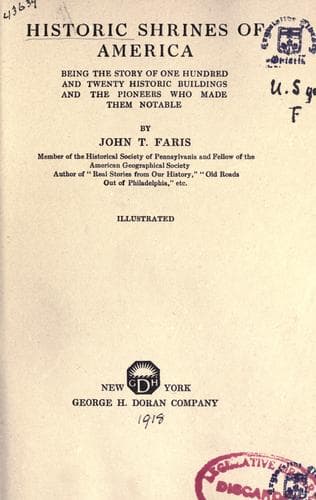
Historic Shrines of America: Being the Story of One Hundred and Twenty Historic Buildings and the Pioneers Who Made Them NotableFaris, John T. (John Thomson)
History
Historic Shrines of America: Being the Story of One Hundred and Twenty Historic Buildings and the Pioneers Who Made Them Notable
Faris, John T. (John Thomson)
Historic buildings -- United States; United States -- Biography
"Under the church of Federal Street,
Under the tread of its Sabbath feet,
Walled about by its basement stones,
Lie the marvellous preacher's bones.
No saintly honors to them are shown,
No sign nor miracle have they known;
But he who passes the ancient church
Stops in the shade of its belfry-porch,
And ponders the wonderful life of him
Who lies at rest in that charnel dim.
Long shall the traveller strain his eye
From the railroad car, as it plunges by,
And the vanishing town behind him search
For the slender spire of the Whitefield Church;
And feel for one moment the ghosts of trade
And fashion and folly and pleasure laid,
By the thought of that life of pure intent,
That voice of warning, yet eloquent,
Of one on the errands of angels sent.
And if where he labored the flood of sin
Like the tide from the harbor-bar sets in.
And over a life of time and sense
The church-spires lift their vain defence,
As if to scatter the bolts of God
With the points of Calvin's thunder-rod,--
Still, as the gem of its civic crown,
Precious beyond the world's renown,
His memory hallows the ancient town!"
XVI
THE FIRST BAPTIST CHURCH, PROVIDENCE, RHODE ISLAND
THE OLDEST BAPTIST CHURCH IN AMERICA
When Roger Williams, Welshman, left England for America because he
could not find in the Church of England freedom to worship God
according to his conscience, he came to Salem, in the Massachusetts
Bay Colony. There he joined others who had sought America for the same
purpose, but to his disappointment he found that his ideas of liberty
of worship did not agree with theirs, and he was once more adrift. On
October 9, 1635, the authorities of the Colony ordered that he "shall
depart out of this jurisdiction." He was later given permission to
remain until spring, on condition that he make no attempt "to draw
others to his opinions."
On the ground that he had broken the implied agreement, the Governor,
on January 11, 1636, sent for him to go to Boston, from whence he was
to be banished to England. Williams sent word that he was ill and
could not come at the time. A force of men was sent to seize him, but
when they reached his house he had departed already, turning his face
toward the southern wilderness. He was "sorely tossed for fourteen
weeks in a bitter winter season, not knowing what bread or bed did
mean."
Public-domain text, read in full here on John Shaqi.
Reviews
Reviews
No reviews yet
Be the first to share your thoughts on this work.
Join the Discussion
Join the discussion
Sign in to leave a comment or review.
Sign InorCreate an account