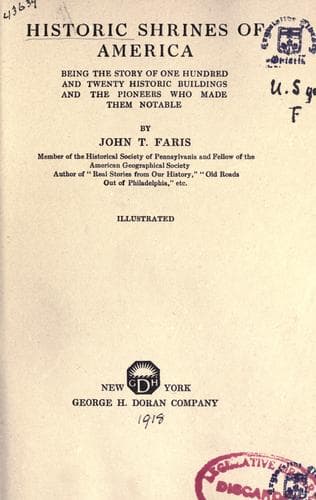
Historic Shrines of America: Being the Story of One Hundred and Twenty Historic Buildings and the Pioneers Who Made Them NotableFaris, John T. (John Thomson)
History
Historic Shrines of America: Being the Story of One Hundred and Twenty Historic Buildings and the Pioneers Who Made Them Notable
Faris, John T. (John Thomson)
Historic buildings -- United States; United States -- Biography
On April 30, 1636, he came to the country of the Wampanoags, where the
sachem Massasoit made him a grant of land. Within a short time some
of his friends joined him, and primitive houses were built. Then came
word from the Governor of Massachusetts Bay that he must go beyond the
bounds of the Plymouth Colony. Accordingly, with six others, he
embarked in canoes and sought for a location. When this was found
Canonicus and Mantonomi agreed to let the company have lands, and soon
the new settlement was made and named Providence, in recognition of
God's care of him during his journey. Then others joined him and his
companions.
Two years after the settlement of Providence twelve of the citizens
decided that they must have a church. One of the company, Ezekiel
Hollyman, baptized Roger Williams and Williams baptized Hollyman and
ten others. The twelve then baptized were the original members of the
first church of Providence, Rhode Island, the first Baptist church in
America, and the second in the world. Roger Williams was the first
pastor, but he withdrew before the close of the year in which the
church was organised. During the remaining forty-five years of his
life he remained in Providence as a missionary among the Indians,
whose friendship he had won by his scrupulously careful and honorable
method of dealing with them.
The church met in private houses or under the trees, for more than
sixty years. The first meeting house was not erected until 1700. The
builder was Pardon Tillinghast, the sixth pastor of the church, who,
like his predecessors, served without salary. However, he urged that
the church should begin to pay its way, and that his successor should
receive a stipulated salary. The Tillinghast building was in use for
fifteen years after it was deeded to the congregation, in 1711. The
deed, which is on record at the Providence City Hall, calls the church
a "Six-Principle church."
The growth of the congregation called for a larger building. This was
erected in 1726 and was used until 1774. An old document gives an
interesting side light on the building of the meeting house. This is
an account of Richard Brown, dated May 30, 1726, which reads:
The account of what charge I have been at this day as to the
providing a dinner for the people that raised the Baptist
meeting-house at Providence (it being raised this day,) is as
followeth:
One fat sheep, which weighed forty-three lbs. L0,14,04
For roasting the said sheep, etc. 8
For one lb. butter 1
For two loaves of bread which weighed fifteen lbs. 2
For half a peck of peas 1,03
Public-domain text, read in full here on John Shaqi.
Reviews
Reviews
No reviews yet
Be the first to share your thoughts on this work.
Elsewhere in the archive
Join the Discussion
Join the discussion
Sign in to leave a comment or review.
Sign InorCreate an account