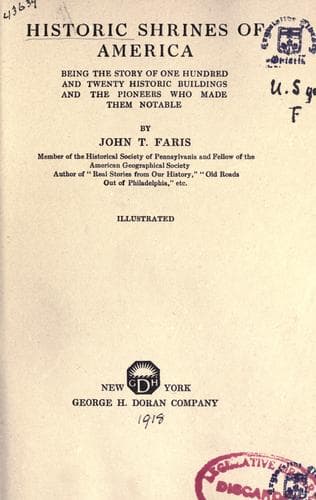
Historic Shrines of America: Being the Story of One Hundred and Twenty Historic Buildings and the Pioneers Who Made Them NotableFaris, John T. (John Thomson)
History
Historic Shrines of America: Being the Story of One Hundred and Twenty Historic Buildings and the Pioneers Who Made Them Notable
Faris, John T. (John Thomson)
Historic buildings -- United States; United States -- Biography
When the building was planned the Charitable Baptist Society was
incorporated, that it might hold title to "a meeting-house for the
public worship of Almighty God, and to hold Commencement in." Nearly a
third of the L7,000 required for the new building was raised by a
lottery, authorized by the State. The architects modelled the church
after the popular St. Martins-in-the-Fields in London, whose designer
was James Gibbs, a pupil of Sir Christopher Wren.
In the two-hundred-foot spire was hung the bell made in London, on
which were inscribed the strange words:
"For freedom of conscience this town was first planted;
Persuasion, not force was used by the people:
This Church is the eldest, and has not recanted,
Enjoying and granting bell, temple, and steeple."
The pastor at the time the new church was first occupied, on May 28,
1775, was president of Rhode Island College, an institution which had
been located in Providence in 1773, in consequence of the generosity
and activity of the members of the church. The institution later
became Brown University. Every one of the presidents of the college
has been a member of the First Church.
A church whose building was dedicated "midway between the battles of
Lexington and Bunker Hill" should have a patriotic history. The story
of Providence during the Revolution shows that the members were keenly
alive to their opportunities. The first suggestion for the Continental
Congress came from Providence. Rhode Island was the first State to
declare for independence. Pastor and people were ardent supporters of
these movements. Many soldiers were furnished to the army by the
congregation.
Naturally, then, people would be interested in a man like Stephen
Gano, who became pastor in 1792. He had been a surgeon in the
Revolutionary Army, and had been taken prisoner, put on board a
prison-ship, and bound in chains, which made scars that lasted for
life. His pastorate of thirty-six years was the longest in the history
of the church.
The stately building erected in 1774 is still in use. The gallery long
set apart for the use of slaves has given way to a square loft, the
old pews have been displaced by modern seats, and the lofty pulpit and
sounding-board have disappeared. Otherwise the church is much as it
was when the first congregation entered its doors in 1775.
TWO: WHERE PATROONS AND KNICKERBOCKERS FLOURISHED
_Where nowadays the Battery lies,
New York had just begun,
A new-born babe, to rub its eyes,
In Sixteen Sixty-One.
They christened it Nieuw Amsterdam,
Those burghers grave and stately,
And so, with schnapps and smoke and psalm,
Lived out their lives sedately._
Public-domain text, read in full here on John Shaqi.
Reviews
Reviews
No reviews yet
Be the first to share your thoughts on this work.
Elsewhere in the archive
Join the Discussion
Join the discussion
Sign in to leave a comment or review.
Sign InorCreate an account