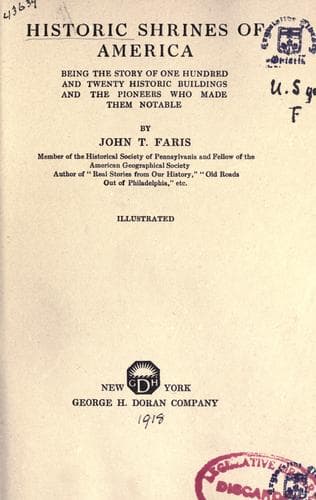
Historic Shrines of America: Being the Story of One Hundred and Twenty Historic Buildings and the Pioneers Who Made Them NotableFaris, John T. (John Thomson)
History
Historic Shrines of America: Being the Story of One Hundred and Twenty Historic Buildings and the Pioneers Who Made Them Notable
Faris, John T. (John Thomson)
Historic buildings -- United States; United States -- Biography
_Two windmills topped their wooden wall,
On stadthuys gazing down,
On fort, and cabbage-plots, and all
The quaintly gabled town;
These flapped their wings and shifted backs,
As ancient scrolls determine,
To scare the savage Hackensacks,
Paumanks, and other vermin_.
_At night the loyal settlers lay
Betwixt their feather-beds;
In hose and breeches walked by day,
And smoked, and wagged their heads.
No changeful fashions came from France,
The vrouwleins to bewilder;
No broad-brimmed burgher spent for pants
His every other guilder._
_In petticoats of linsey red,
And jackets neatly kept,
The vrouws their knitting-needles sped
And deftly spun and swept.
Few modern-school flirtations there
Set wheels of scandal trundling,
But youths and maidens did their share
Of staid, old-fashioned bundling._
EDMUND CLARENCE STEDMAN.
TWO: WHERE PATROONS AND KNICKERBOCKERS FLOURISHED
[Illustration: MORRIS-JUMEL HOUSE, NEW YORK CITY.
_Photo by Frank Cousins Art Company_
See page 87]
XVII
THE MORRIS-JUMEL MANSION, NEW YORK CITY
WHERE WASHINGTON ESCAPED FROM THE BRITISH BY A FIFTEEN MINUTE MARGIN
"A Pleasant situated Farm, on the Road leading to King's
Bridge, in the Township of Harlem, on York-Island, containing
about 100 acres, near 30 acres of which is Wood-land, a fine
piece of Meadow Ground, and more easily be made: and commands
the finest Prospect in the whole Country: the Land runs from
River to River: there is Fishing, Oystering, and Claming at
either end...."
When, in 1765, Roger Morris, whose city house was at the corner of
Whitehall and Stone streets, saw this advertisement in the New York
_Mercury_, he hungered for the country. So he bought the offered land,
and by the summer of 1766 he had completed the sturdy Georgian house
that, after a century and a half, looks down on the city that has
grown to it and beyond it.
In an advertisement published in 1792, in the New York _Daily
Advertiser_, a pleasing description of the mansion of Roger Morris was
given:
"On the premises is a large dwelling-house, built in modern
style and taste and elegance. It has ... a large hall
through the centre; a spacious dining room on the right....
On the left is a handsome parlor and a large back room.... On
the second floor are seven bedchambers ... On the upper floor
are five lodging rooms ... and at the top of the house is
affixed an electric conducter. Underneath the building are a
large, commodious kitchen and laundry and wine cellar,
storeroom, kitchen pantry, sleeping apartments for servants,
and a most complete dairy room...."
Public-domain text, read in full here on John Shaqi.
Reviews
Reviews
No reviews yet
Be the first to share your thoughts on this work.
Elsewhere in the archive
Join the Discussion
Join the discussion
Sign in to leave a comment or review.
Sign InorCreate an account