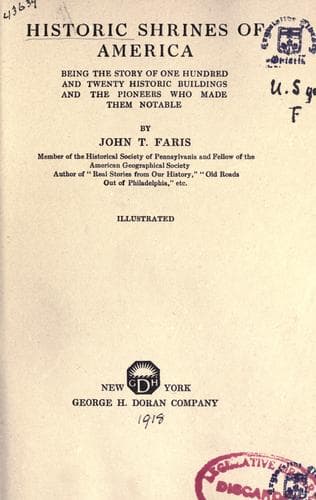
Historic Shrines of America: Being the Story of One Hundred and Twenty Historic Buildings and the Pioneers Who Made Them NotableFaris, John T. (John Thomson)
History
Historic Shrines of America: Being the Story of One Hundred and Twenty Historic Buildings and the Pioneers Who Made Them Notable
Faris, John T. (John Thomson)
Historic buildings -- United States; United States -- Biography
For nine years Roger Morris and his family lived in the mansion on the
Heights. As a member of the Legislative Council much of his time was
given to the interests of his fellow-citizens. But as time passed he
found himself out of sympathy with his neighbors. They demanded war
with Great Britain, and he felt that he could not join the revolt.
Accordingly, in 1775, he sailed for England, leaving his large
property in the care of Mrs. Morris.
Mrs. Morris kept the house open for a time, but finally, taking her
children with her, she went to her sister-in-law at the Philipse Manor
House at Yonkers.
On September 14, 1776, General Washington decided to abandon the city
to the British. He planned to go to Harlem, to the fortification
prepared in anticipation of just such an emergency. On September 15 he
took possession of the Roger Morris house as headquarters. Two days
later his Orderly Book shows the following message, referring to the
battle of Harlem Heights:
"The General most heartily thanks the troops commanded
yesterday by Major Leitch, who first advanced upon the enemy,
and the others who so resolutely supported them. The behavior
of yesterday was such a contrast to that of some troops the
day before [at Kip's Bay] as must show what may be done when
Officers and Soldiers exert themselves."
During the weeks when the mansion remained Washington's headquarters
the curious early flag of the colonists waved above it. In the space
now given to the stars was the British Union Jack, while the thirteen
red and white stripes that were to become so familiar completed the
design. This flag the English called "the Rebellious Stripes."
On November 16, 1776, Washington was at Fort Lee, on the New Jersey
shore, opposite the present 160th Street. Desiring to view from the
Heights the British operations in their attack on Fort Washington, he
crossed over to the Morris house. Fifteen minutes after he left the
Heights to return to New Jersey, fourteen thousand British and Hessian
troops took possession of the Heights, the Morris Mansion, and Fort
Washington.
The period of British occupation continued, at intervals, until near
the close of the war. Since the owner was a Loyalist, the British
Government paid rent for it.
After the Revolution the property was confiscated, as appears from an
entry in Washington's diary, dated July 10, 1790:
"Having formed a Party consisting of the Vice-President, his
lady, Son & Miss Smith; the Secretaries of State, Treasury, &
War, and the ladies of the two latter; with all the Gentlemen
of my family, Mrs. Lear & the two Children, we visited the
old position of Fort Washington, and afterwards dined on a
dinner provided by a Mr. Mariner at the House lately Colo.
Roger Morris, but confiscated and in the occupation of a
common Farmer."
Public-domain text, read in full here on John Shaqi.
Reviews
Reviews
No reviews yet
Be the first to share your thoughts on this work.
Elsewhere in the archive
Join the Discussion
Join the discussion
Sign in to leave a comment or review.
Sign InorCreate an account