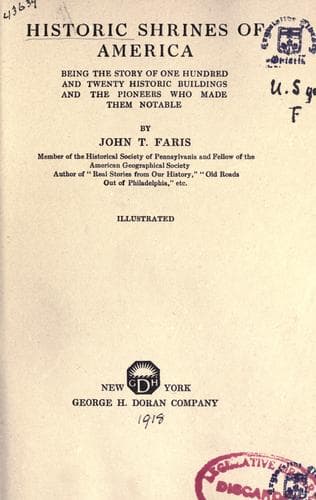
Historic Shrines of America: Being the Story of One Hundred and Twenty Historic Buildings and the Pioneers Who Made Them NotableFaris, John T. (John Thomson)
History
Historic Shrines of America: Being the Story of One Hundred and Twenty Historic Buildings and the Pioneers Who Made Them Notable
Faris, John T. (John Thomson)
Historic buildings -- United States; United States -- Biography
For nearly thirty years after the Revolution the stately old house was
occupied as a farmhouse or as a tavern. In 1810 it became the home of
Stephen Jumel, a wealthy New York merchant, whose widow, Madam Jumel,
later gave such wonderful entertainments in the house that the whole
city talked about her. After many years of life alone in the mansion,
in July, 1833, she married Aaron Burr. He was then seventy-two years
old, while she was fifty-nine.
Madam Jumel-Burr lived until July 16, 1865. During her last years she
was demented and did many strange things. For a time she maintained an
armed garrison in the house, and she rode daily about the grounds at
the head of fifteen or twenty men.
The mansion passed through a number of hands until, in 1903, title to
it was taken by the City of New York, on payment of $235,000.
For three years the vacant house was at the mercy of souvenir hunters,
but when, in 1906, it was turned over to the Daughters of the American
Revolution, to be used as a Revolutionary Museum, twelve thousand
dollars were appropriated for repairs and restoration. This amount was
woefully inadequate, but it is hoped that further appropriation will
make complete restoration possible.
The spacious grounds that once belonged to the mansion have been sold
for building lots, but the house looks down proudly as ever from its
lofty site almost opposite the intersection of Tenth Avenue and One
Hundred and Sixty-first Street with St. Nicholas Avenue. The corner
of its original dooryard is now Roger Morris Park.
[Illustration: PHILIPSE MANOR HOUSE, YONKERS, N. Y.
_Photo by A. V. Card, Yonkers_
See page 91]
XVIII
THE PHILIPSE MANOR HOUSE, YONKERS, NEW YORK
THE HOME OF MARY PHILIPSE, IN WHOM GEORGE WASHINGTON WAS INTERESTED
At first glance one would not think that the name Yonkers was derived
very directly from the name of the first settlers of the region, de
Jonkheer Adriaen Van der Donck. When, in 1646, he secured a large
tract of land bounded by the Hudson, the Bronx, and Spuyten Duyvil
Creek, this was called "Colen Donck" (Donck's Colony) or "De
Jonkheer's" (the Young Lord's). As the Dutch "j" is pronounced "y,"
the transition from Jonkheers to Yonkers was easy.
On September 29, 1672, after the death of the original owner, 7,708
acres of the princely estate were sold to three men, of whom Frederick
Philipse (originally Ffreric Vlypse) was one. A few years later
Philipse bought out the heirs of the other two purchasers, and added
to his holdings by further purchases from his countrymen and from the
Indians. On June 12, 1693, he was permitted to call himself lord of
the Manor of Philipsburgh. From that day the carpenter from Friesland,
who had grown so rich that he was called "the Dutch millionaire,"
lived in state in the house he had begun in 1682.
Public-domain text, read in full here on John Shaqi.
Reviews
Reviews
No reviews yet
Be the first to share your thoughts on this work.
Elsewhere in the archive
Join the Discussion
Join the discussion
Sign in to leave a comment or review.
Sign InorCreate an account