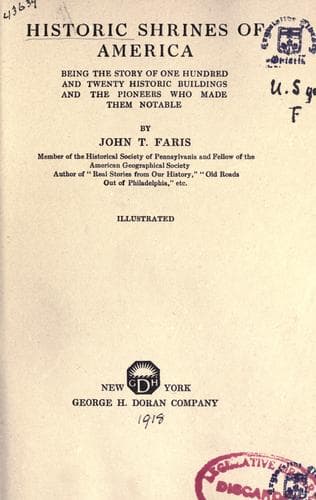
Historic Shrines of America: Being the Story of One Hundred and Twenty Historic Buildings and the Pioneers Who Made Them NotableFaris, John T. (John Thomson)
History
Historic Shrines of America: Being the Story of One Hundred and Twenty Historic Buildings and the Pioneers Who Made Them Notable
Faris, John T. (John Thomson)
Historic buildings -- United States; United States -- Biography
This lord of the manor became still more important in consequence of
the acceptance of his offer to build a bridge over Spuyt-den-duyvil,
or "Spiting Devil" Creek, when the city declined to do so for lack of
funds. The deed given to him stated that he had "power and authority
to erect a bridge over the water or river commonly called Spiten devil
ferry or Paparimeno, and to receive toll from all passengers and
drovers of cattle that shall pass thereon, according to rates
hereinafter mentioned." This bridge, which was called Kingsbridge, was
a great source of revenue until 1713, when it was removed to the
present site. Then tolls were charged until 1759, or, nominally, until
1779.
Part of the Manor House was used as a trading post. Everything
Philipse handled seemed to turn into gold. All his ventures prospered.
It was whispered that some of these ventures were more than a little
shady, that he had dealings with pirates and shared in their
ill-gotten gains, and that he even went into partnership with Captain
Kidd when that once honest man became the prince of the very pirates
whom the Government had commissioned him to apprehend. And Philipse,
as a member of the Governor's Council, had recommended this Kidd as
the best man for the job! It is not strange that the lord of the manor
felt constrained to resign his seat in the council because of the
popular belief in the statement made by the Governor, that "Kidd's
missing treasures could be readily found if the coffers of Frederick
Philipse were searched."
Colonel Frederick Philipse, the great-grandson of Captain Kidd's
partner, enlarged the Manor House to its present proportions and
appearance. He also was prominent in the affairs of the Colony. He was
a member of the Provincial Assembly, and was chairman of a meeting
called on August 20, 1774, to select delegates to the county
convention which was to select a representative to the First
Continental Congress. Thus, ostensibly, he was taking his place with
those who were crying out for the redress of grievances suffered at
the hands of Great Britain. Yet it was not long until it was evident
that he was openly arrayed with those who declined to turn from their
allegiance to the king.
The most famous event that took place in the Philipse Manor was the
marriage, on January 28, 1758, of the celebrated beauty, Mary
Philipse, to Colonel Roger Morris. A letter from Joseph Chew to George
Washington, dated July 13, 1757, shows that--in the opinion of the
writer, at least--the young Virginian soldier was especially
interested in Mary Philipse. In this letter, which he wrote after his
return from a visit to Mrs. Beverly Robinson in New York, the sister
of Mary Philipse, he said:
Public-domain text, read in full here on John Shaqi.
Reviews
Reviews
No reviews yet
Be the first to share your thoughts on this work.
Elsewhere in the archive
Join the Discussion
Join the discussion
Sign in to leave a comment or review.
Sign InorCreate an account