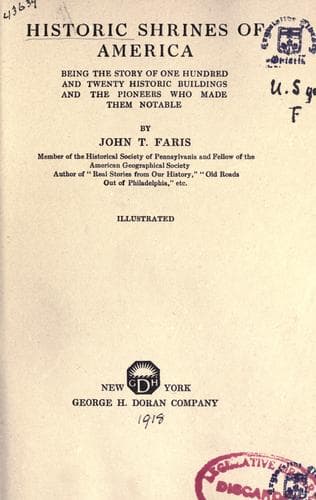
Historic Shrines of America: Being the Story of One Hundred and Twenty Historic Buildings and the Pioneers Who Made Them NotableFaris, John T. (John Thomson)
History
Historic Shrines of America: Being the Story of One Hundred and Twenty Historic Buildings and the Pioneers Who Made Them Notable
Faris, John T. (John Thomson)
Historic buildings -- United States; United States -- Biography
"I often had the Pleasure of Breakfasting with the Charming
Polly, Roger Morris was there (Don't be startled) but not
always, you know him he is a Lady's man, always something to
say, the Town talk't of it as a sure & settled Affair. I
can't say I think so and that I much doubt it, but assure you
had Little Acquaintance with Mr. Morris and only slightly
hinted it to Miss Polly, but how can you be Excused to
Continue so long in Phila. I think I should have made a kind
of Flying March of it if it had been only to have seen
whether the Works were sufficient to withstand a Vigorous
Attack, you a soldier and a Lover, mind I have been arguing
for my own Interest now for had you taken this method then I
should have had the Pleasure of seeing you--my Paper is
almost full and I am Convinced you will be heartily tyred in
Reading it--however will just add that I intend to set out
to-morrow for New York where I will not be wanting to let
Miss Polly know the Sincere Regard a Friend of mine has for
her--and I am sure if she had my Eyes to see thro would
Prefer him to all others."
While it is true that George Washington went to New York to see the
charming Polly, there is no evidence that he was especially interested
in her.
Colonel Morris later built for his bride the Morris-Jumel Mansion,
which is still standing near 160th Street. Mrs. Morris frequently
visited at the home of her girlhood. The last visit was paid there
during Christmas week of 1776. Her father, who had been taken to
Middletown, Connecticut, because of his activities on the side of the
king, was allowed to go to his home on parole.
In 1779 the Manor House and lands were declared forfeited because the
owner refused to take the oath of allegiance to the Colonies, and
Frederick Philipse, III, went to England.
The property was sold in 1785. Until 1868 it was in the hands of
various purchasers. To-day the Manor House is preserved as a relic of
the days when Washington visited the house, when loyalists were driven
from the doors, and when it was the centre of some of the important
movements against the British troops.
XIX
ST. PAUL'S CHAPEL, NEW YORK CITY
WHERE WASHINGTON ATTENDED SERVICE ON HIS FIRST INAUGURATION DAY
In the New York _Gazette_ of May 14, 1764, appeared this notice
concerning St. Paul's Chapel:
"We are told that the Foundation Stone of the third English
Church which is about erecting in this City, is to be laid
this day. The church is to be 112 by 72 feet."
For two years those who passed the corner of Broadway and Partition
(Fulton) Street watched the progress of the building. On October 30,
1766, it was ready for the first service.
Public-domain text, read in full here on John Shaqi.
Reviews
Reviews
No reviews yet
Be the first to share your thoughts on this work.
Elsewhere in the archive
Join the Discussion
Join the discussion
Sign in to leave a comment or review.
Sign InorCreate an account