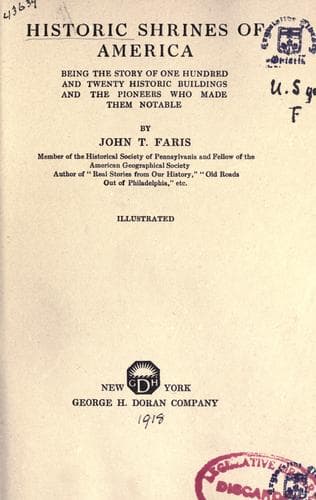
Historic Shrines of America: Being the Story of One Hundred and Twenty Historic Buildings and the Pioneers Who Made Them NotableFaris, John T. (John Thomson)
History
Historic Shrines of America: Being the Story of One Hundred and Twenty Historic Buildings and the Pioneers Who Made Them Notable
Faris, John T. (John Thomson)
Historic buildings -- United States; United States -- Biography
"The scruples of a Christian have determined me to expose my
own life to any extent rather than subject myself to the
guilt of taking the life of another. This much increases my
hazards, and redoubles my pangs for you....
"If it had been possible for me to have avoided the
interview, my love for you and my precious children would
have been alone a decisive motive. But it was not possible,
without sacrifices which would have rendered me unworthy of
your esteem."
Mrs. Hamilton remained at The Grange as long as possible, directing
the men in the care of the estate and caring for her children. But she
could not afford to keep a carriage, and the inaccessibleness of the
estate and the drain it made on her limited purse soon made it
necessary for her to rent a house in the city.
Though friends proposed the raising of a fund that would care for Mrs.
Hamilton and the children, it does not seem that there was any relief
until 1816, when Congress gave to Mrs. Hamilton back pay amounting to
ten thousand dollars.
After The Grange was sold to pay debts, its career was checkered. Some
years ago it was moved to the east side of Convent Avenue, and it then
became the schoolhouse of St. Luke's Episcopal Church.
[Illustration: VAN CORTLANDT HOUSE, NEW YORK CITY
_Photo by Ph. B. Wallace_
See page 104]
XXII
THE VAN CORTLANDT HOUSE, NEW YORK CITY
AT THE EDGE OF THE MANHATTAN "NEUTRAL GROUND"
In 1699 Jacobus Van Cortlandt bought the first fifty acres of the
ground now included in Van Cortlandt Park, New York City, and for one
hundred and ninety years the property remained in the Van Cortlandt
family. Until fifty-three years before the first of the Van
Cortlandts acquired it, the Indians were the undisputed possessors of
the plot.
Adriaen Van der Donck, the first settler to acquire title, lived until
his death in the _bouwerie_ or farmhouse, which he built on the shore
of a brook. When Jacobus Van Cortlandt built his _bouwerie_ by the
side of the same brook, he dammed the water to make a mill-pond, which
is to-day the beautiful Van Cortlandt lake. There he built a grist
mill which remained in use until 1889. Early visitors to the lake
delighted to study the ancient structure to which, during the
Revolution, both British and patriot soldiers resorted with their
grain. The mill was struck by lightning and destroyed in 1901.
The third house on the estate was built in 1748 by Frederick the son
of Jacobus, who acquired by the will of his father the "farm, situate,
lying, and being in a place commonly called and known by the name of
Little or Lower Yonkers." This house, which was modelled after the
Philipse Manor House at Yonkers, is still in a fine state of
preservation. Since 1897, it has been used as a public museum, in
charge of the Colonial Dames of the State of New York.
Public-domain text, read in full here on John Shaqi.
Reviews
Reviews
No reviews yet
Be the first to share your thoughts on this work.
Elsewhere in the archive
Join the Discussion
Join the discussion
Sign in to leave a comment or review.
Sign InorCreate an account