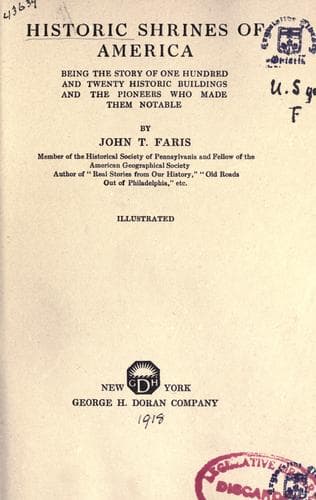
Historic Shrines of America: Being the Story of One Hundred and Twenty Historic Buildings and the Pioneers Who Made Them NotableFaris, John T. (John Thomson)
History
Historic Shrines of America: Being the Story of One Hundred and Twenty Historic Buildings and the Pioneers Who Made Them Notable
Faris, John T. (John Thomson)
Historic buildings -- United States; United States -- Biography
The room fitted up as a museum was occupied by General Washington on
the occasion of his visit to the house in 1783. This room is also
pointed out as the scene of the death of Captain Rowe of the Hessian
jaegers, who was severely wounded near the house. When he realised
that he could not recover, he sent in haste for the young woman who
had promised to marry him, and he died in her arms.
Other famous visitors were Rochambeau, Admiral Digby, and William
Henry, Duke of Clarence, who became King William IV of England.
Admiral Digby, after his departure, sent to Augustus Van Cortlandt,
the owner of the house, two wooden vultures, which he had captured
from a Spanish privateer. These vultures are now in the museum.
The old house was the centre of important military operations during
the Revolution. Washington fortified eight strategic spots in the
vicinity of Kingsbridge, and when he withdrew before the British
occupied the fortification, a number of Hessian jaegers were quartered
in the Van Cortlandt House. To the north of the house was the neutral
ground for which the two armies continually struggled for possession.
In 1781, when Washington was about to withdraw his army to Yorktown,
he directed that camp-fires be lit on Vault Hill, the site of the Van
Cortlandt family vault. By this stratagem he succeeded for a time in
deceiving the enemy as to his movements.
Since the building of the Broadway subway Van Cortlandt Park has been
so easy of access that the number of visitors to the historic spot has
rapidly increased.
XXIII
THE HASBROUCK HOUSE, NEWBURGH, NEW YORK
WHERE THE CLOSING DRAMA OF THE REVOLUTION WAS STAGED
During the entire period of the Revolution the country about Newburgh
was an important centre of military operations. West Point was
fortified in 1776, that the British might not be able to carry out
their design of separating New England from the middle colonies. Many
officers had their headquarters within a few miles of these
fortifications. Lafayette was at the Williams House, three miles north
of Newburgh, while Generals Green, Gates, and Knox were at Vail's
Gate, four miles south of the town. General George Clinton was at
Little Britain, and General Anthony Wayne was in Newburgh.
Washington's first stay in the vicinity was at Vail's Gate, New
Windsor, in the winter of 1779-80. His longest sojourn, however, was
in the house which Jonathan Hasbrouck built in 1750 and enlarged in
1770. The best description of this substantial one-story stone house
at the time of Washington's residence there is contained in the
"Memoirs" of Marquis de Chastellux, who was the guest of the
Commander-in-chief on December 6, 1872:
Public-domain text, read in full here on John Shaqi.
Reviews
Reviews
No reviews yet
Be the first to share your thoughts on this work.
Elsewhere in the archive
Join the Discussion
Join the discussion
Sign in to leave a comment or review.
Sign InorCreate an account