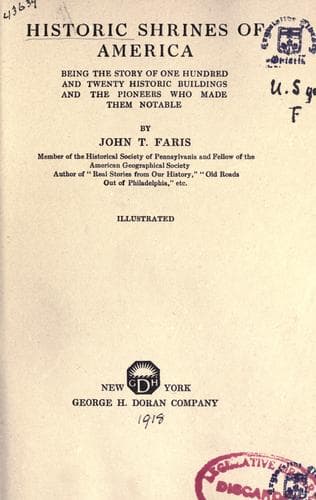
Historic Shrines of America: Being the Story of One Hundred and Twenty Historic Buildings and the Pioneers Who Made Them NotableFaris, John T. (John Thomson)
History
Historic Shrines of America: Being the Story of One Hundred and Twenty Historic Buildings and the Pioneers Who Made Them Notable
Faris, John T. (John Thomson)
Historic buildings -- United States; United States -- Biography
"SIR: With a mixture of great surprise and astonishment, I
have read with attention the sentiments you have submitted
to my perusal. Be assured, Sir, no occurrence in the course
of the war has given me more painful sensations, than your
information of there being such ideas existing in the army,
as you have expressed, and I must view with abhorrence and
reprehend with severity. For the present the Communication of
this will rest in my own bosom, unless some further agitation
of the matter shall make a disclosure necessary.
"I am much at a loss to conceive what part of my conduct
could have given encouragement to an address, which to me
seems big with the greatest mischiefs that can befall my
country. If I am not deceived in the knowledge of myself, you
could not have found a person to whom your schemes are more
disagreeable. At the same time, in justice to my own
feelings, I must add that no man possesses a more sincere
wish to see ample justice done to the Army than I do, and so
far as my power and influence, in a constitutional way,
extend, they shall be employed to the utmost of my abilities
to effect it, should there be any occasion. Let me conjure
you then, if you have any regard for your country, concern
for yourself or respect for me, to banish these thoughts from
your mind, and never communicate, as from yourself or any one
else, a sentiment of the like nature.
"With esteem I am, sir, Your most obedient servant,
"GEORGE WASHINGTON."
That Washington desired to be a simple resident on his own estate at
Mount Vernon instead of king of the new country, was emphasized by a
letter written on June 15 to Archibald Cary:
"I can truly say, that the first wish of my soul is to return
speedily into the bosom of that country which gave me birth,
and, in the sweet enjoyment of domestic happiness and the
company of a few friends, to end my days in quiet, when I
shall be called from this stage."
There was joy in the village on the banks of the Hudson when, late in
1782, a letter came from Sir Guy Carleton announcing that negotiations
for a general peace had already begun in Paris, and that the king had
decided to propose the independence of the thirteen Provinces "in the
first instance, instead of granting it as a condition of a general
treaty."
In the long interval before the receipt of decisive word concerning
peace, the sagacity of Washington was once more tested severely. There
was still disaffection among the officers and the men because they had
not been paid, and because Congress seemed to pay no attention to
their protests. Washington learned that a call had been issued for a
meeting of officers to be held in New Windsor to consider taking
matters into their own hands and forcing Congress to act.
Public-domain text, read in full here on John Shaqi.
Reviews
Reviews
No reviews yet
Be the first to share your thoughts on this work.
Elsewhere in the archive
Join the Discussion
Join the discussion
Sign in to leave a comment or review.
Sign InorCreate an account