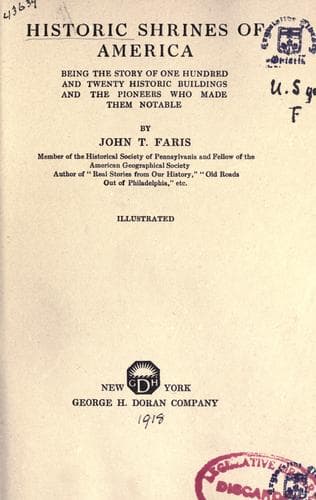
Historic Shrines of America: Being the Story of One Hundred and Twenty Historic Buildings and the Pioneers Who Made Them NotableFaris, John T. (John Thomson)
History
Historic Shrines of America: Being the Story of One Hundred and Twenty Historic Buildings and the Pioneers Who Made Them Notable
Faris, John T. (John Thomson)
Historic buildings -- United States; United States -- Biography
"The largest room in it, (which was the proprietor's parlor
for his family, and which General Washington has converted
into his dining-room) is in truth tolerably spacious, but it
has seven doors and only one window. The chimney, or rather
the chimney back, is against the wall; so that there is in
fact but one vent for the smoke, and the fire is in the room
itself. I found the company assembled in a small room, which
served by way of parlor. At nine supper was served, and when
the hour of bed-time came, I found that the chamber, to which
the General conducted me, was the very parlor I speak of,
wherein he had made them place a camp bed...."
The records of the months when Washington was an occupant of the old
Dutch house are among the most interesting of the war. For instance,
on May 10, 1782, there came tidings of the arrival in New York of Sir
Guy Carleton, the new British commander, who wrote that he desired to
tell of the king's idea of a possible peace, and of the attitude of
the House of Commons. He closed his letter by saying, "If war must
prevail, I shall endeavor to render its miseries as light to the
people of this continent as the circumstances of such a condition will
possibly permit."
Two days earlier Washington wrote a letter to Meschech Weare in which
he seems to have anticipated and discredited Carleton's word of
appeal:
"They are meant to amuse this country with a false idea of
peace, to draw us off from our connection with France, and to
lull us into a state of security and inactivity, which having
taken place, the ministry will be left to prosecute the war
in other parts of the world with greater vigor and effect."
In less than two weeks a tempter of an entirely different sort
approached Washington. Lewis Nicola, colonel of the corps of invalids,
wrote to tell of the fact that the officers and soldiers were
discontented because they had not received their pay. Then he
intimated that he had no hope of the success of republican
institutions, but thought this country needed a ruler like a king,
though he might not be called king, owing to the objection to that
word. Yet he added, "I believe strong arguments might be produced for
admitting the title of KING, which I conceive would be attended with
some material advantages."
To this letter Washington sent prompt reply, on May 22, 1782:
Public-domain text, read in full here on John Shaqi.
Reviews
Reviews
No reviews yet
Be the first to share your thoughts on this work.
Elsewhere in the archive
Join the Discussion
Join the discussion
Sign in to leave a comment or review.
Sign InorCreate an account