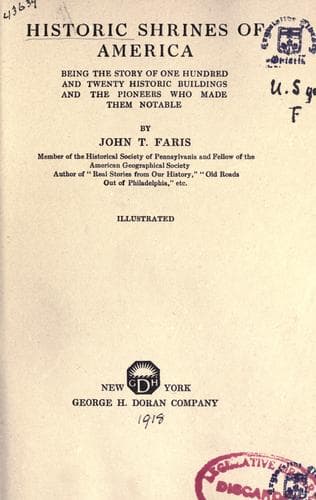
Historic Shrines of America: Being the Story of One Hundred and Twenty Historic Buildings and the Pioneers Who Made Them NotableFaris, John T. (John Thomson)
History
Historic Shrines of America: Being the Story of One Hundred and Twenty Historic Buildings and the Pioneers Who Made Them Notable
Faris, John T. (John Thomson)
Historic buildings -- United States; United States -- Biography
The year after the death of Mr. Tennent, on Sunday, June 28, 1778,
General Washington, at the head of about six thousand men, hurried by
Old Tennent. That morning he had been at Englishtown where the sound of
cannon told him his advance forces under General Lee were battling with
the British. Washington was about one hundred yards beyond the church
door when he met the first straggler who told him that Lee had
retreated before the British. A little further on the Commander-in-chief
met Lee. After rebuking him sharply he hastened forward, and rallied
the retreating Continentals. The renewed battle continued until
evening when the British were driven back to a defensive position.
During the night they retired, to the surprise of Washington, who
hoped to renew the battle in the morning. The victory snatched from
defeat in this, one of the most stubbornly contested and longest
battles of the war, gave new courage to the Colonies.
During the battle wounded soldiers were carried to the church, where
members of the congregation tended them, in what could not have been a
very secure refuge, since musket balls pierced the walls. An exhausted
American soldier, while trying to make his way to the building, sat
for rest on the grave of Sarah Mattison. While he was there a cannon
ball wounded him and broke off a piece of the headstone. Watchers
carried him into the church where he was laid on one of the pews. The
stains of blood are still to be seen on the board seat, while the
marks of his hands were visible on the book-rest of the pew until the
wood was grained.
A tablet has been placed on the front wall of the church with this
message:
1778-1901
In Grateful Remembrance
of Patriots Who, on Sabbath June 28, 1778,
Gained the Victory Which Was the Turning Point
Of the War for Independence,
And to Mark a Memorable Spot on
The Battlefield of Monmouth,
This Tablet is placed by Monmouth Chapter
Daughters of the American Revolution
September 26, 1901.
Not far from the church is the monument commemorating the battle
itself. Spirited bronze reliefs on this tell the story of some of the
picturesque incidents of the memorable struggle.
XXVII
THE FORD MANSION, MORRISTOWN, NEW JERSEY
FROM WHICH ALEXANDER HAMILTON WENT COURTING
New Jersey, which was the scene of so many battles during the
Revolution, was also the scene of what was perhaps Washington's
pleasantest winter during the war. From December, 1799, to June, 1780,
the Commander-in-chief lived at the Ford Mansion with his "family," as
he was fond of calling Mrs. Washington and his aides.
During these months he was busily engaged in making plans for the
later successful conduct of the war, yet he took time for those social
relaxations which were a needed relief from the anxious strain of the
long conflict.
Public-domain text, read in full here on John Shaqi.
Reviews
Reviews
No reviews yet
Be the first to share your thoughts on this work.
Elsewhere in the archive
Join the Discussion
Join the discussion
Sign in to leave a comment or review.
Sign InorCreate an account