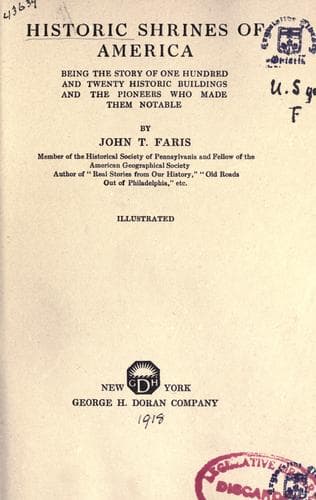
Historic Shrines of America: Being the Story of One Hundred and Twenty Historic Buildings and the Pioneers Who Made Them NotableFaris, John T. (John Thomson)
History
Historic Shrines of America: Being the Story of One Hundred and Twenty Historic Buildings and the Pioneers Who Made Them Notable
Faris, John T. (John Thomson)
Historic buildings -- United States; United States -- Biography
Among those who helped to make that winter memorable were Surgeon
General John Cochrane and Mrs. Cochrane, who occupied the Campfield
House close by, and General and Mrs. Philip Schuyler, who had come
down from Albany for a season at headquarters. Mrs. Schuyler and Mrs.
Cochrane were sisters. Elizabeth Schuyler had come in advance of her
parents, and for a time was a guest at the Campfield House.
Visitors from France were arriving from time to time, bringing word of
the alliance that was to mean so much to the Colonies, and conferring
as to methods of cooperation.
In one wing of the Ford Mansion lived Mrs. Ford and her son Timothy.
In the rooms set apart for the use of Washington's family eighteen
people were crowded. Two of these were Alexander Hamilton and Tench
Tilghman, both members of the General's staff.
Though Mrs. Washington delighted to put on style, on occasion, she
could also be plain and simple. There had been times during the war
when she was not ashamed to drive to headquarters in a coach and four.
But sometimes at Morristown she was in a different mood--as, for
instance, one day when a number of the ladies of the neighborhood,
dressed in their best, called to pay their respects to her. To their
surprise they found her sitting in a speckled apron, knitting
stockings. If they were ill at ease at first, their state of mind can
be imagined when their hostess began to talk to them of the need of
care in their expenditures for their country's sake. After telling
them of a dress she had made out of the carefully unravelled
upholstery of a set of chairs, she completed their consternation by
saying:
"American ladies should be patterns of industry to their
countrywomen, because the separation from the mother-country
will dry up the source whence many of our comforts have been
derived. We must become independent by our determination to
do without what we cannot make ourselves. While our husbands
and brothers are examples of patriotism, we must be examples
of thrift and economy."
Public-domain text, read in full here on John Shaqi.
Reviews
Reviews
No reviews yet
Be the first to share your thoughts on this work.
Elsewhere in the archive
Join the Discussion
Join the discussion
Sign in to leave a comment or review.
Sign InorCreate an account