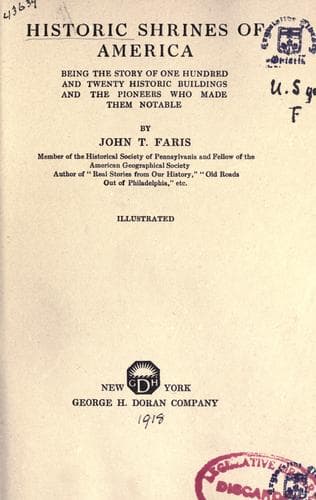
Historic Shrines of America: Being the Story of One Hundred and Twenty Historic Buildings and the Pioneers Who Made Them NotableFaris, John T. (John Thomson)
History
Historic Shrines of America: Being the Story of One Hundred and Twenty Historic Buildings and the Pioneers Who Made Them Notable
Faris, John T. (John Thomson)
Historic buildings -- United States; United States -- Biography
"You cannot, my dear sir, be more happy at the connexion you
have made with my family than I am. Until the child of a
parent has made a judicious choice, his heart is in critical
anxiety; but this anxiety was removed the moment I discovered
on whom she had placed her affection. I am pleased with every
instance of delicacy in those who are dear to me; and I think
I read your soul on that occasion you mention. I shall
therefore only entreat you to consider me as one who wishes
in every way to promote your happiness, and I shall."
The young people were married at the Schuyler homestead in Albany on
December 14, 1780.
To-day the Ford Mansion where Hamilton dreamed of a conquest in which
the British had no part is owned by the Washington Association of New
Jersey, and is open to visitors. The Campfield House is to be found on
a side street; it has been moved from its original site.
[Illustration: NASSAU HALL AND THE FIRST PRESIDENT'S HOUSE,
_Photo by R. H. Rose and Son, Princeton_ PRINCETON, N. J.
See page 130]
XXVIII
NASSAU HALL, PRINCETON, NEW JERSEY
WHERE THE CONGRESS OF 1783 MET FOR FIVE MONTHS
Where the College of New Jersey, as Princeton University was
officially known until 1896, erected its first building at Princeton,
the far-sighted trustees arranged what was long ago the largest stone
structure in the Colonies. The records of early travellers on the road
between Philadelphia and New York tell of their amazement at the
wonderful building.
In 1756 the college abandoned its rooms in the First Presbyterian
Church of Newark, New Jersey, and occupied the ambitious quarters in
Princeton, which had cost about L2,900.
Originally the halls extended from end to end of Nassau Hall, a
distance of one hundred and seventy-five feet. These long, brick-paved
halls afforded students inclined to mischief wonderful opportunity to
make life miserable for the tutors who were charged with their
oversight. "Rolling heated cannon balls, to tempt zealous but unwary
tutors, was a perennial joy," writes Varnum Lansing Collins, in his
book, "Princeton." Then he adds the statement that at a later epoch
there were wild scenes, "when a jackass or a calf was dragged
rebelliously up the narrow iron staircase, to be pitted in frenzied
races with the model locomotive purloined from the college museum."
There was no provision for lighting the long halls, so the rollicking
students were accustomed to fix candles to the walls with handfuls of
mud. When a tutor was heard approaching, the candles would be blown
out and he would be foiled in his attempt to identify the offenders.
Sometimes barricades of cordwood were built hastily on the stairs or
across the entrance to one of the halls.
Public-domain text, read in full here on John Shaqi.
Reviews
Reviews
No reviews yet
Be the first to share your thoughts on this work.
Elsewhere in the archive
Join the Discussion
Join the discussion
Sign in to leave a comment or review.
Sign InorCreate an account