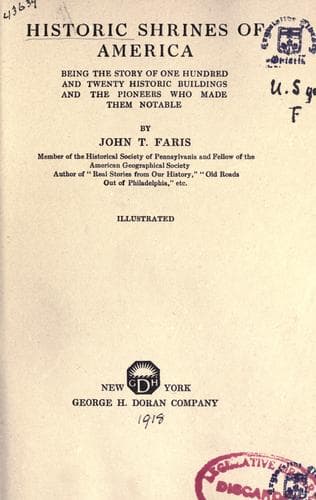
Historic Shrines of America: Being the Story of One Hundred and Twenty Historic Buildings and the Pioneers Who Made Them NotableFaris, John T. (John Thomson)
History
Historic Shrines of America: Being the Story of One Hundred and Twenty Historic Buildings and the Pioneers Who Made Them Notable
Faris, John T. (John Thomson)
Historic buildings -- United States; United States -- Biography
In vain the authorities tried to correct these abuses by the passage
of strict regulations. "No jumping or hollowing or any boisterous
Noise shall be suffered, nor walking in the gallery in the time of
Study," was a regulation which could be made known far more easily
than it could be enforced. Lest there be breaches of decorum inside
the rooms, tutors were directed to make at least three trips a day to
the quarters of the students, to see that they were "diligent at the
proper Business." They were to announce their coming to a room "by a
stamp, which signal no scholar shall imitate on penalty of five
shillings." Should the occupant of the room refuse to open the door,
the tutor had authority to break in. At a later date, students in
Nassau Hall liked to have double doors to their rooms, so that the
obnoxious tutor might be hindered in his efforts to force an entrance,
long enough to give them opportunity to hide all evidence of
wrongdoing.
In 1760 a code of "orders and customs" was issued by the authority of
President Aaron Burr. One of the most astounding directions in this
code was that "Every Freshman sent on an errand shall go and do it
faithfully and make quick return." Other rules, as indicated in Mr.
Collins' book, concerned deportment, and demanded constant deference
to superiors. "Students are to keep their hats off 'about ten rods to
the President and about five to the tutors;' they must 'rise up and
make obeisance' when the President enters or leaves the prayer hall,
and when he mounts into the pulpit on Sundays. When walking with a
superior, an inferior 'shall give him the highest place.' When first
coming into the presence of a superior, or speaking to him, inferiors
'shall respect by pulling their Hats;' if overtaking or meeting a
superior on the stairs, he 'shall stop, giving him the banister side;'
when entering a superior's, 'or even an equal's' room, they must
knock; if called or spoken to by a superior, they must 'give a direct,
pertinent answer concluding with sir;' they are to treat strangers and
townspeople 'with all proper complaisance and good manners;' and they
are forbidden to address any one by a nickname."
Evidently rules like these helped to make good patriots, for Princeton
students were among the most sturdy adherents of the Colonists' cause.
In September, 1770, the entire graduating class wore American cloth,
as a protest against Great Britain's unjust taxation measures.
In January, 1774, the students broke into the college storeroom and
carried the winter's supply of tea to a bonfire in front of Nassau
Hall. While the tea burned the college bell tolled and the
students--in the words written home to a parent by one of them--made
"many spirited resolves."
Public-domain text, read in full here on John Shaqi.
Reviews
Reviews
No reviews yet
Be the first to share your thoughts on this work.
Elsewhere in the archive
Join the Discussion
Join the discussion
Sign in to leave a comment or review.
Sign InorCreate an account