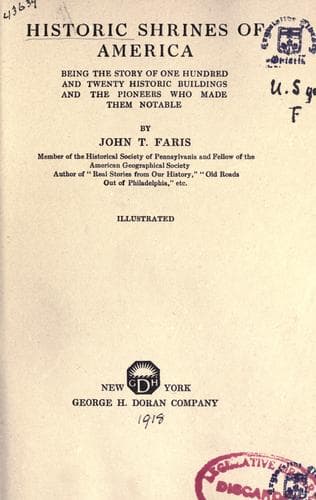
Historic Shrines of America: Being the Story of One Hundred and Twenty Historic Buildings and the Pioneers Who Made Them NotableFaris, John T. (John Thomson)
History
Historic Shrines of America: Being the Story of One Hundred and Twenty Historic Buildings and the Pioneers Who Made Them Notable
Faris, John T. (John Thomson)
Historic buildings -- United States; United States -- Biography
"Sollemnity & Distress appeared almost on every countenance,
several students that had come 5 & 600 miles & just got
letters in college were now obliged under every disadvantage
to retire with their effects, or leave them behind, which
several through the impossibility of getting a carriage at so
Confused a time were glad to do, & lose them all, as all
hopes of continuing longer in peace at Nassau were now taken
away I began to look out for some place where I might pursue
my studies & as Mr. G. Johnson had spoke to me to teach his
son I accordingly went there & agreed to stay with him till
spring."
So wrote John Clark, one of the students at the College of New Jersey,
who, in 1776, was dismayed by the threatened approach of Cornwallis
and his army. He was able to remove his effects in ample time, for he
had only a "Trunk & Desk." But there were others in the peaceful
village who were not so fortunate. One of them was Mrs. Richard
Stockton of Morven, a beautiful home still standing not far from the
college campus. The activity of her husband in the interests of the
Colonies had angered the British, and they were not slow to take
advantage of the absence of the family by pillaging the mansion and
destroying many things it contained. Fortunately Mrs. Stockton, before
leaving hurriedly for Freehold, had buried the family silver, and this
was not discovered, though Cornwallis and his officers occupied the
house as headquarters.
Probably, while they were here, they talked gleefully of what they
called the collapse of the war. They felt so sure that the war was
over that Cornwallis was already planning to return to England.
Then came the surprise at Trenton, when nearly a thousand Hessians of
a total force of twelve hundred were captured.
Immediately Cornwallis, who had returned to New York, hastened back to
Princeton, where he left three regiments and a company of cavalry.
Then he hurried on to Trenton. On the way he was harassed by
Washington's outposts, and the main force of the General delayed his
entrance into the town until nightfall. He expected to renew the
attack next morning, but during the night Washington stole away toward
Princeton. Within two miles of Princeton the force of General Mercer
encountered the reserve troops of Cornwallis, which were on their way
to their commander's assistance. Washington, hearing the sound of the
conflict that followed, hastened to the field in time to rally the
forces of Mercer, who had been wounded. The day was saved, but General
Mercer was lost; he died in the farmhouse on the battle field to which
he was carried. To this day visitors are shown the stain made on the
floor by the blood of the dying man. Those who express doubt as to
the stain are not welcomed.
Public-domain text, read in full here on John Shaqi.
Reviews
Reviews
No reviews yet
Be the first to share your thoughts on this work.
Elsewhere in the archive
Join the Discussion
Join the discussion
Sign in to leave a comment or review.
Sign InorCreate an account